Custodial vs Non-Custodial Bitcoin Wallets Explained
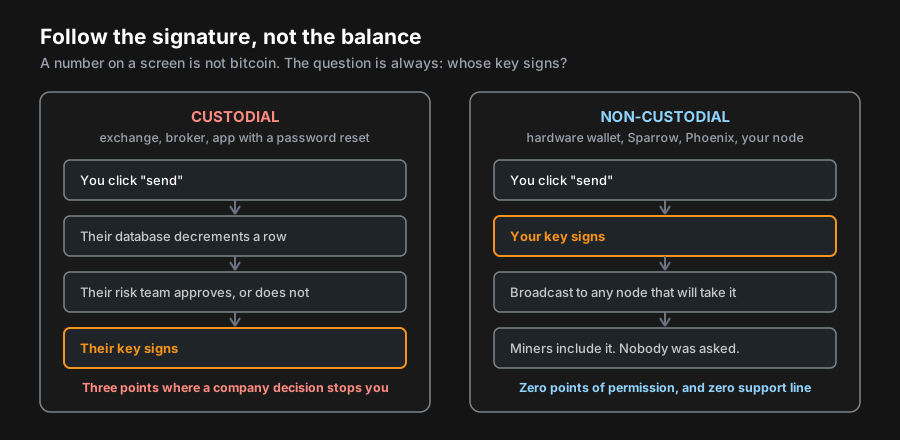
There is exactly one question, and it is not about apps or interfaces. Whose key signs the transaction? If a company signs on your behalf, the wallet is custodial and your balance is a claim against that company. If you sign, it is non-custodial and the coins move when you decide they move. Everything else, the fees, the design, the support chat, follows from that one fact.
Most people using Bitcoin in 2026 are custodial and have never thought about it, because a custodial balance behaves exactly like a non-custodial one right up until the day it does not. This is what the difference actually costs, in both directions.
What does custodial actually mean?
When you buy bitcoin on an exchange, in most cases no Bitcoin transaction happens. The exchange updates a row in its own database. Your coins are commingled with everyone else's in addresses the exchange controls, and what you own is an entry in a ledger you cannot audit, backed by a promise.
That promise is usually kept. Exchanges are useful, liquidity lives there, and telling people never to touch one is unhelpful advice that nobody follows. But it is worth being precise about what you are holding, because the failures of the last few years were not failures of Bitcoin. They were failures of promises.
The tell is always the same: if you can reset your password and get your money back, someone else holds the key. That is not a criticism, it is a definition. A recovery mechanism that works without your key is a recovery mechanism that works without you.
| Custodial | Non-custodial | |
|---|---|---|
| Who signs | the provider | you |
| What you hold | a claim in a private database | an unspent output on the public chain |
| Forgot your credentials | reset and continue | the coins are gone, permanently |
| Provider goes insolvent | you join the creditor queue | no effect whatsoever |
| Account frozen or withdrawals paused | possible, and it has happened | not a thing that exists |
| Identity required | yes, and it is retained | no |
| Small internal transfers | instant and free | on-chain fee, or use Lightning |
| Who you must trust | a company, its lenders and its counterparties | your own backup discipline |
| Realistic worst case | cents on the dollar, years later | a burned seed phrase and nobody to call |
What happens to your coins if the exchange fails?
This stopped being hypothetical some time ago, and the useful thing is that both a major exchange and a bankruptcy court have now told us in plain language.
Start with the exchange. In its quarterly filing with the SEC for the first quarter of 2022, Coinbase disclosed that because custodially held crypto assets may be considered property of a bankruptcy estate, in the event of a bankruptcy those assets could be subject to bankruptcy proceedings and customers "could be treated as our general unsecured creditors." Coinbase was not in trouble; a new accounting rule simply obliged the disclosure. The company was describing the ordinary legal position of a pooled custodian.
Now the court. On 4 January 2023, Judge Glenn of the United States Bankruptcy Court for the Southern District of New York held that customer deposits in Celsius Earn accounts were property of the bankruptcy estate. The Earn programme was about $4.2 billion, some 77 percent of platform assets. The reasoning was not exotic crypto law. It was contract law: the terms of use unambiguously granted title to Celsius, the clickwrap agreement was binding, and 99.86 percent of account holders had accepted version 6 or later of those terms. Arguments that words like "loan" created ambiguity were rejected.
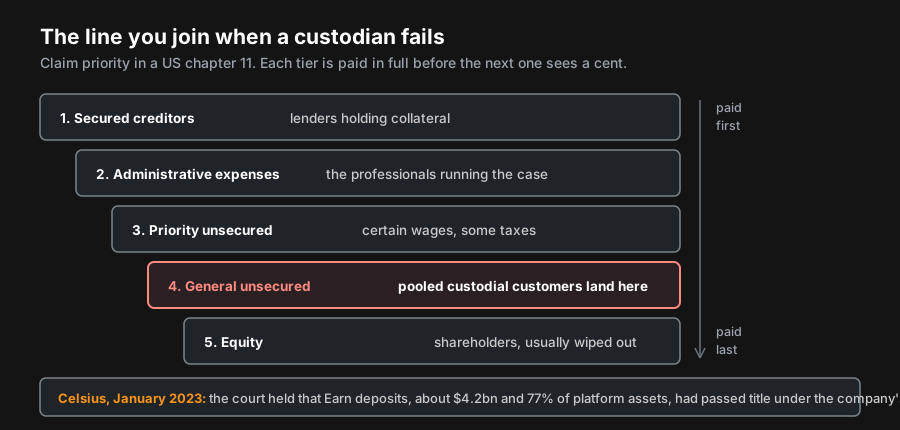
Read those two things together and the lesson is uncomfortable but simple. Nobody stole anything. The terms said what they said, people clicked accept, and a judge enforced the plain language. The document that decides who owns your coins is the one you did not read.
Worth noting what this does not say. Segregated custody, where a trust company holds coins in dedicated addresses under a proper custodial agreement, sits on much firmer ground than a pooled account with a yield product bolted on. The Celsius holding turned on Celsius's own terms. Other terms produce other outcomes, which is precisely why the terms are worth ten minutes of your attention before you deposit anything you would miss.
Does proof of reserves fix this?
Partly, and less than the phrase implies.
A reserves attestation demonstrates that coins existed in addresses the exchange controlled at a particular moment. That is genuinely better than nothing, and an exchange refusing to publish one in 2026 is telling you something. But consider what it leaves out. It does not show whether those coins are pledged as collateral elsewhere. It does not show whether they were borrowed for the morning of the snapshot. And critically, it says nothing about liabilities unless the liability side is included and independently verified, which is the hard half and the half most often skipped.
A useful attestation covers both sides, is repeated often enough that a snapshot cannot be gamed, and is performed by someone independent. Judge them on those three properties rather than on the presence of the phrase. You can check the reserve addresses yourself using any of the tools in our block explorer guide, which is more than most people who cite proof of reserves ever do.
How can you tell whether a wallet is really non-custodial?
Plenty of apps use the words "your keys" in marketing while holding, escrowing or backing up those keys somewhere you cannot see. Four questions settle it, and you can run all four in about five minutes.
- Did it show you a seed phrase and make you write it down? If setup never produced twelve or twenty-four words, or produced them and then offered to keep a copy for you, be sceptical. A wallet that can restore your funds without your input holds something that restores your funds.
- Is there a password reset that returns your money? Custody and recoverability are the same property viewed from two sides. If an email link can get your balance back, an email compromise can get your balance too.
- Can you restore the wallet somewhere else? The real test. Take the seed phrase to a different, unrelated wallet and see whether the same balance appears. If it does, the keys are genuinely yours and the original app is replaceable. If it does not, either the derivation path is unusual or the app was never what it claimed.
- Does it publish the addresses it derives? A non-custodial wallet will happily show you your own receiving addresses, which you can then look up on any explorer and watch independently.
One clarification that trips people up constantly: a hardware wallet is not a separate category from a non-custodial wallet. It is a way of doing non-custodial storage where the key lives on a dedicated device instead of a general-purpose computer. A software wallet on your phone with a seed phrase you wrote down is also non-custodial; it is simply less well defended. Custody is about who holds the key. The device is about how well that key is protected once it is yours.
Isn't self-custody how people lose everything?
Sometimes, yes, and pretending otherwise is how newcomers get talked into setups they cannot operate.
Self-custody does not remove risk. It swaps a risk you cannot inspect for one you can. You stop worrying about a balance sheet you will never see and start worrying about a seed phrase, a passphrase, a fire, and whether anyone else on earth knows the wallet exists. Those are real, and they have taken far more coins out of circulation than any exchange collapse.
The difference that matters is testability. You cannot audit an exchange's solvency. You absolutely can wipe your hardware wallet and restore it from your backup before you fund it, and confirm in twenty minutes that your recovery works. One of these failure modes can be rehearsed. The other announces itself in a press release.
That is the actual argument for self-custody, and it is more modest than the slogans: not that it is safe, but that its failures are yours to prevent. The methods, and the ways people get them wrong, are laid out in our cold storage guide.
There is a second cost worth stating plainly, because the enthusiast case tends to skip it. Self-custody makes you the target. Nobody phones a Coinbase customer pretending to be Coinbase and walks away with the whole balance in one move, because withdrawal limits, holds and a fraud team sit in the way. Those same frictions are absent by design when you hold the keys, which is why so much of the social engineering catalogued in our scams guide is aimed squarely at self-custody users. The defence is procedural rather than technical: verify addresses on the device screen, never type a seed phrase into anything, and treat urgency itself as the warning sign.
None of which argues for leaving coins on an exchange. It argues for being honest that moving to self-custody is taking on a job, not shedding one. People who understand that going in do fine. People who were told it was simply "safer" are the ones who end up on the wrong end of a support-impersonation call six months later.
It is not a binary
The debate is usually framed as exchange or nothing, which skips the options that suit most people best.
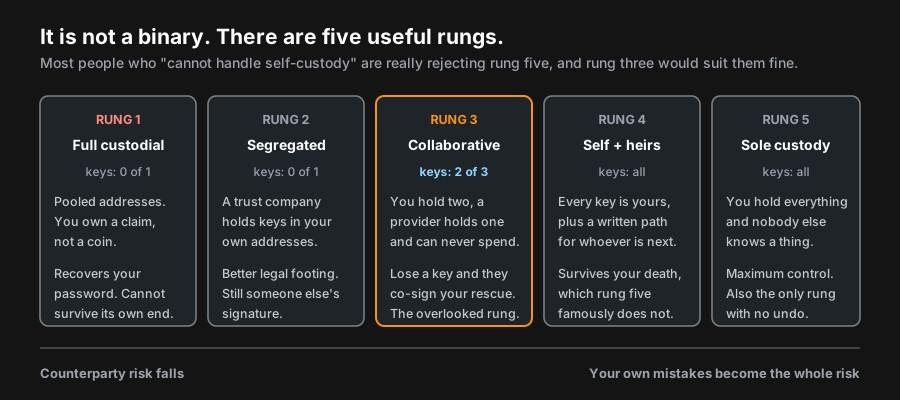
Collaborative custody is worth understanding properly. It is typically a 2-of-3 multisig in which you hold two keys and a service holds the third. The service cannot spend, because one signature is not two. But if you lose one of your keys, it can co-sign your recovery. You have removed the single point of failure that makes sole custody frightening without handing anyone the ability to freeze, lend out or lose your coins.
The trade is a subscription and a company that must still exist when you need it. Test the recovery path when you set it up, not when you need it, and make sure you can rebuild the wallet from your own two keys plus the descriptor if the provider vanishes. A collaborative setup you cannot escape from is just a custodian with extra steps.
So which should you use?
Both, for different jobs. That is not a hedge, it is how anyone who has done this a while actually operates.
| What you are doing | Use | Why |
|---|---|---|
| Buying, selling, trading | custodial exchange | That is where the liquidity is. Move the result out afterwards. |
| Spending small amounts | non-custodial phone wallet, or Lightning | Fast and cheap. Keep only what you would carry as cash. |
| Holding for years | non-custodial, hardware wallet | No counterparty, no terms of use, no queue. |
| Holding a lot, worried about your own mistakes | collaborative custody | A co-signer who can rescue you but cannot rob you. |
| Holding a lot, comfortable with process | 2-of-3 multisig you control | No single key, no single building, no subscription. |
| An ETF or a brokerage exposure | custodial by definition | Fine as a financial product. It is not bitcoin you can move. |
If you hold a spot ETF, be clear with yourself about what it is. It is exposure to a price, held by a custodian, tradeable during market hours, and useful for exactly that. It is not a bitcoin you can send to anyone, and the distinction stops being academic the moment either of those properties is the one you need. We covered the structure of those products in our spot Bitcoin ETF guide.
The practical move, if you have been meaning to do this for a while: withdraw a small amount to a wallet you control this week. Not the whole balance. Enough that the withdrawal, the fee, and the arrival are real to you rather than theoretical. Then wipe the device, restore from your backup, and confirm the coins reappear. People who have done that once behave completely differently from people who have only read about it, and the exercise costs a few thousand satoshis. Our buying guide walks through the withdrawal step.
Related on BTCLinks
Sources
- Coinbase Global, Form 10-Q for the quarter ended 31 March 2022. The risk-factor language quoted above appears verbatim in this filing. Read directly from the SEC EDGAR archive and verified 2026-07-29.
- Morrison Foerster on In re Celsius Network LLC. Source of the 4 January 2023 date, Judge Glenn and the Southern District of New York, the $4.2 billion and 77 percent figures, the 99.86 percent acceptance of terms version 6 or later, and the contract-law reasoning. Verified 2026-07-29.
- Sidley Austin on the same ruling. Independent legal summary confirming the holding and the limitation that individual customers may still raise defences. Verified 2026-07-29.
- BIP-39: Mnemonic code for generating deterministic keys. The standard behind the seed phrase that makes non-custodial recovery possible at all. Verified 2026-07-29.
- 11 U.S. Code § 507, Priorities. The statutory basis for the claim ordering shown in the waterfall diagram. Verified 2026-07-29.
Some links are affiliate links. As an Amazon Associate we earn from qualifying purchases. Not financial advice, and nothing here is legal advice about your own holdings.