Best VPNs for Bitcoin and Crypto Privacy
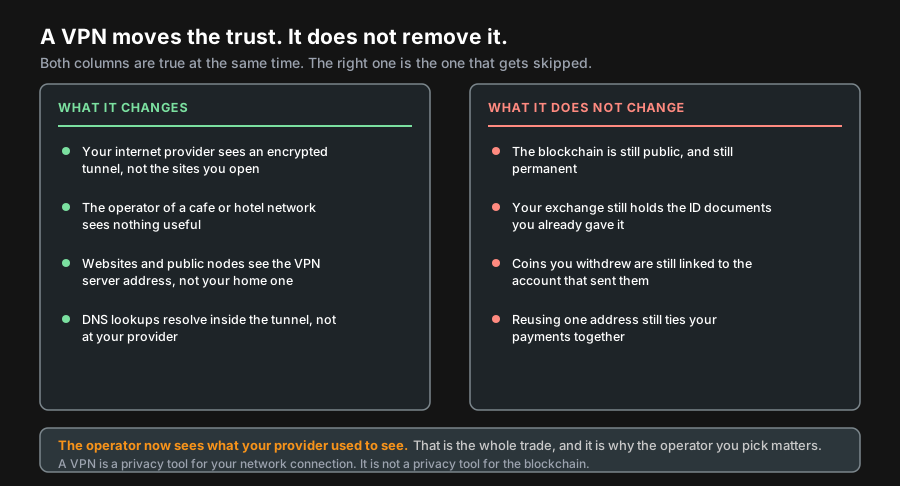
Start with the part most articles on this subject bury. A VPN does not make a Bitcoin transaction private. The chain is public and permanent, and no tunnel changes that. A VPN does not defeat exchange KYC either; a platform that already holds your passport scan still holds it whichever IP you log in from. What a VPN does is move one specific piece of trust: your internet provider stops seeing which sites and nodes you connect to, and the VPN operator starts seeing it instead. That is a genuine improvement for some threats and completely irrelevant to others.
What a VPN actually buys a Bitcoin user
Three things, and they are worth having.
The first is that your internet provider stops building a log of which crypto services you use. Connecting to an exchange, a block explorer or a wallet's servers is a pattern, and that pattern is visible to whoever carries your traffic. A VPN replaces it with one encrypted connection to one place.
The second matters if you run your own node or wallet software. Broadcasting a transaction reveals your IP address to the peers you send it to, and network-level observation of broadcast origin is a documented way to associate transactions with a person. Sending it through a tunnel breaks that particular link, though our guide to running a full node covers stronger options for that specific problem.
The third is public networks. On hotel or cafe wifi, the operator of that network sees your traffic patterns and can attempt to interfere with them. A VPN removes them from the picture entirely, and this is the least glamorous and most consistently useful reason to have one.
What it does not do, stated plainly
| The concern | Does a VPN help? | What actually addresses it |
|---|---|---|
| Your ISP logging which crypto sites you visit | Yes | A VPN, or Tor |
| Cafe or hotel wifi watching your traffic | Yes | A VPN, or Tor |
| Your IP being seen when you broadcast a transaction | Partly | Tor, or broadcasting through your own node |
| Anyone reading your transaction history on-chain | No | Nothing at the network layer. The chain is public |
| Your exchange knowing who you are | No | You already gave them documents |
| Withdrawals being linked back to your exchange account | No | Care about address reuse and how coins are combined |
| Chain analysis clustering your addresses | No | On-chain practice, not network routing |
| Being identified by your browser fingerprint | No | Browser configuration, not the tunnel |
There is a fourth thing worth flagging because it costs people accounts. Logging into an identity-verified exchange from a country you have never used before is a fraud signal, and platforms act on it. Reviews, holds and frozen withdrawals follow. We cover the broader pattern of what goes wrong with exchange accounts in our scams guide, and the general question of who you are defending against in our threat model guide. If your account is verified, connecting to it through a foreign exit node buys you nothing and risks a lot.
The four providers, and what we could verify
We checked each provider's own site rather than repeating the affiliate roundups, and the table below reports what we found, including where we found nothing. That last part matters: a blank is not an accusation, it means we could not verify a claim from a page we could load, and we would rather say so than fill it in.
| Mullvad | Proton VPN | IVPN | NordVPN | |
|---|---|---|---|---|
| Jurisdiction | Sweden Mullvad VPN AB, Gothenburg | Switzerland | Gibraltar | Panama |
| Dedicated no-logs audit | Not found. Security audits yes, a no-logs attestation no | Securitum, June 2026, fifth consecutive annual | Cure53, March 2019. The only one | Deloitte, Dec 2025, sixth engagement |
| Most recent published audit of any kind | Leviathan, Android app, 1 Jun 2026 | The no-logs audit above | Web infrastructure, most recent of six | Cure53 apps and systems, 2025 |
| Crypto accepted | Bitcoin, Bitcoin Cash, Monero | Bitcoin only | Bitcoin, Monero | Yes, coins not named on its payments page |
| Other private payment | Cash by post | Cash by post (CHF, USD, EUR) | Cash, and voucher cards | Cash via retail stores |
| Email required to sign up | No. A random account number | Yes | No. A generated Account ID | Yes |
| Runs its own DNS | Yes, a non-logging resolver on each server | Yes, resolved inside the tunnel | Yes, a zero-logging resolver applied automatically | Yes, company-operated resolvers by default |
What the audit column really means
Proton VPN has the strongest position on this specific point. Securitum performed a no-logs audit in June 2026, the fifth consecutive annual one, and Proton publishes the full report. The stated conclusion is careful rather than triumphant, which is a good sign: the evidence reviewed "did not indicate" that the examined infrastructure logs browsing activity, DNS queries, destination services, traffic contents or user-identifiable connection metadata.
NordVPN commissioned Deloitte for an assurance engagement conducted under ISAE 3000 (Revised), running from 10 November to 12 December 2025, with the report issued on 12 December 2025. It describes this as its sixth such engagement, with earlier ones performed by PricewaterhouseCoopers. One caveat we will state rather than hide: NordVPN's blog and pricing pages returned a bot challenge to us and we could not render them directly, so those details come from NordVPN's own pages as surfaced through search of its domain rather than from a page we loaded ourselves. Its support article on payment methods, which we did load, confirms cryptocurrency is accepted but does not name a single coin.
A note on what we did not find, and why we are printing it anyway. Roundups in this category tend to write "independently audited" in every row, because a blank column looks like a failure. It is not. Mullvad below has more third-party scrutiny than anyone else here and no no-logs attestation we could locate, and both halves of that sentence are useful. If you see this page contradicted by a list that gives all four providers the same tick, check which one of us named a firm and a date.
Mullvad is the interesting case, because it is the provider most often described as audited and the one with no no-logs attestation we could find. What it does have is an unusually long list of published third-party security audits: Cure53 on infrastructure in June 2024, Radically Open Security on infrastructure in August 2023, X41 D-Sec on the account and payment API in January 2026, Assured on the web application in October 2025, Leviathan on the Android app in June 2026. That is more external scrutiny than most, and it is scrutiny of a different thing. Mullvad's stronger argument is structural rather than evidentiary: it never asks for an email address, issues a random account number, and states it stores no activity logs at all.
IVPN has a real no-logs audit, performed by Cure53 in March 2019, which found its privacy statements verifiable within the defined scope and produced one low-impact DNS caching finding that IVPN then removed. The report is public. The honest caveat is the date: that engagement is over seven years old, and IVPN's later Cure53 work covered gateway infrastructure, apps and web rather than repeating the no-logs examination.
Why "independently audited" deserves less weight than it gets
An audit is evidence about a scope during a window. It is not a permanent property of a company, and treating it as one is how the marketing wins.
Ask three questions of any audit before you let it decide anything. Who performed it, and are they a firm with a reputation to lose? When did the engagement actually run, as opposed to when the blog post was published? NordVPN's engagement window of 10 November to 12 December 2025 is more informative than "audited 2025". And what was in scope? An application penetration test and a no-logs examination are both audits and they answer entirely different questions.
| Provider | Who | When the engagement ran | Was a no-logs claim in scope? |
|---|---|---|---|
| Proton VPN | Securitum | June 2026 | Yes, and it is the whole scope |
| NordVPN | Deloitte | 10 Nov to 12 Dec 2025 | Yes, under ISAE 3000 (Revised) |
| IVPN | Cure53 | March 2019 | Yes, and it has not been repeated |
| Mullvad | Cure53, Assured, X41, Leviathan, ROS | Aug 2023 through Jun 2026 | No. Infrastructure, apps and payment API |
A word on free VPNs
Do not use one for this. A VPN operator carries every connection you make, and running that infrastructure costs money, so a service with no subscription is being paid by someone else for something. In the best case that is an upsell funnel and a slow connection. In the worse cases documented over the years it has meant injected advertising, sold traffic data, or a client that is itself the problem.
The whole argument for using a VPN with Bitcoin is that you are choosing which party gets to see your traffic. Choosing one whose business model depends on doing something with that traffic gives away the only thing you were buying. Mullvad is five euros a month flat. Paying it is the entire defence.
The structural point matters more than any certificate. A provider that never collects your email, issues a random account number, and takes Monero has arranged things so that there is less to hand over, whoever asks. That is a stronger guarantee than a promise not to look at data you did give them, because it does not depend on the promise holding.
However good the policy is, you still paid for it
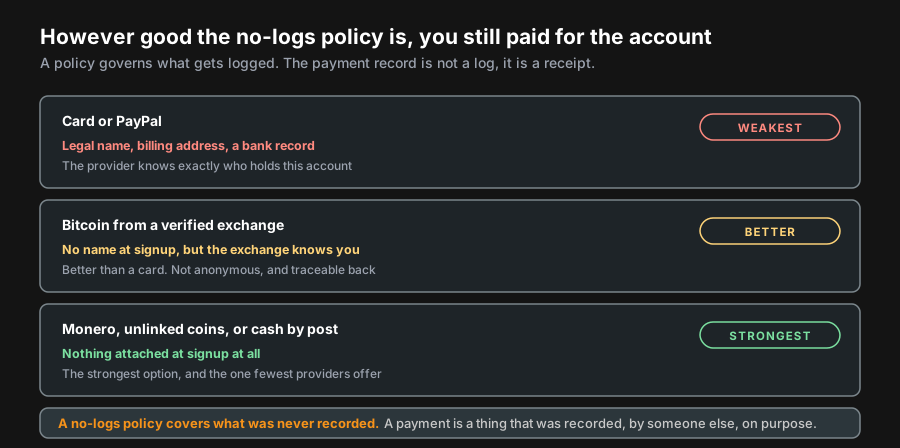
Paying with Bitcoin from an exchange account that has your passport on file is better than a card and it is not anonymity. The exchange knows who bought those coins, the payment is on a public ledger, and the two can be joined up. It is a meaningful improvement over handing over a billing address, and it should not be mistaken for the strongest version.
The strongest version is a payment that carries nothing: Monero, coins that never touched a verified account, or physical cash in an envelope. Mullvad and IVPN both accept Monero and neither requires an email address, which is why they keep appearing at the top of lists written by people who actually care about this rather than people optimising commission. Proton VPN accepts Bitcoin but not until after you have created an account and gone to upgrade it from inside, which is a real friction worth knowing about before you plan around it.
One more consideration that has nothing to do with privacy and everything to do with sense: do not pay for a multi-year subscription in bitcoin if you would rather still own the bitcoin. That is a disposal, and in the US it is a taxable one, as our tax guide sets out.
Tor is the stronger tool, and it costs you something
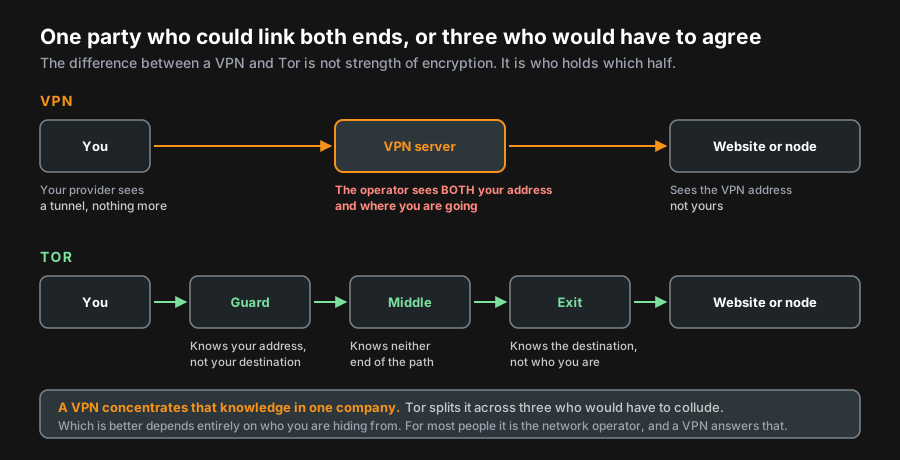
The trade is straightforward once the diagram is in front of you. With a VPN you trust one operator not to record or reveal the link between you and your destination. With Tor no single relay holds both halves, so a meaningful compromise requires parties who do not know each other to cooperate.
Tor is not free of cost. It is slower, some exchanges and websites block or challenge traffic from its exit nodes, and configuring a wallet or node to use it properly takes more effort than installing an app. Those are real reasons people choose a VPN, and they are legitimate reasons rather than laziness.
The practical answer for most Bitcoin users is that these are not competing products. Use a VPN as the default for ordinary traffic on networks you do not control, and use Tor for the specific things where you actually want anonymity rather than confidentiality: broadcasting transactions, connecting to your own node from outside, or reading things you would rather your provider not associate with you.
How we would choose
If the point is privacy rather than watching a different country's streaming catalogue, the order that falls out of the table above is not the order the affiliate industry publishes.
Mullvad and IVPN lead on the property that cannot be walked back: neither needs an email address, both accept Monero, and both accept cash. Mullvad's flat pricing and refusal to run tiered plans is a further sign of a company not optimising for the same things as the rest of the category. Proton VPN has the best current audit evidence and Swiss jurisdiction, and it is the one to pick if a recent, published, dedicated no-logs examination is what reassures you. NordVPN has the longest formal assurance record and the largest server network, and it is the weakest of the four on the specific things this article is about: an email is required, and its own payments page will not tell you which coins it takes.
| If your priority is | The choice that follows | What it costs you |
|---|---|---|
| Attaching no identity at all | Mullvad or IVPN, paid in Monero or cash | Fewer servers, no consumer polish |
| Recent, published no-logs evidence | Proton VPN | An email address, and Bitcoin only after signup |
| Flat pricing and no upsell tiers | Mullvad | No free tier to try first |
| Server count and connection speed | NordVPN | The weakest privacy signup of the four |
| Genuine anonymity, not confidentiality | Tor, not a VPN at all | Speed, and sites that block exit nodes |
| On-chain transaction privacy | None of the above | This is not a problem a VPN can touch |
Whichever you choose, the diagram at the top of this page is the thing to keep. A VPN is a good tool for the network layer and it does nothing whatsoever for the chain. If on-chain privacy is what you are actually after, that is a separate discipline built on address hygiene, on how coins are combined, and on not handing an exchange a lifetime record in the first place. Our guides to address types and to block explorers are a reasonable place to see how much is visible before you decide how much you mind.
Related on BTCLinks
Sources
- Mullvad: No-logging of user activity policy. Source of the Swedish jurisdiction and the Mullvad VPN AB entity in Gothenburg, the statement that no activity logs of any kind are kept, the random account number with no username, password or email, and the payment data retention described. Verified 2026-07-29.
- Mullvad: published audits. Source of the Cure53 infrastructure audit dated 27 June 2024, the Radically Open Security infrastructure audit dated 9 August 2023, the X41 D-Sec account and payment services audit dated 21 January 2026, the Assured web application assessment dated 23 October 2025, and the Leviathan Security Group Android assessment dated 1 June 2026. No dedicated no-logs attestation was found on this page. Verified 2026-07-29.
- Mullvad pricing. Source of the flat rate of 5 euros a month with no tiers, the accepted payment list including Bitcoin, Bitcoin Cash, Monero and cash sent by post, and the discount applied to cryptocurrency payments. Verified 2026-07-29.
- Mullvad: DNS servers and privacy. Source of the statement that each Mullvad VPN server runs its own DNS resolver and that queries are routed through the tunnel to it. Verified 2026-07-29.
- Proton VPN: no-logs audit. Source of the auditor Securitum, the June 2026 date, the description as the fifth consecutive annual audit, the published full report, and the quoted conclusion about browsing activity, DNS queries, destination services, traffic contents and connection metadata. Verified 2026-07-29.
- Proton VPN: payment options. Source of the accepted methods including Bitcoin and cash in CHF, USD and EUR, and of the condition that Bitcoin does not appear as an option at account creation and requires upgrading from within an existing account. Verified 2026-07-29.
- IVPN privacy policy. Source of the Gibraltar registration and the specific no-logging commitments on traffic, connection timestamps, DNS requests, bandwidth and customer IP addresses. Verified 2026-07-29.
- IVPN: no-logging claim verified by independent audit. Source of the Cure53 no-logs audit in March 2019, its scope across VPN gateway and authentication servers, the finding that privacy statements were verifiable within that scope, and the single low-impact DNS caching issue that was then removed. Verified 2026-07-29.
- IVPN: accepted payment methods. Source of Bitcoin via IVPN's own BTCPay server, Monero via its own node, cash, and voucher cards. Verified 2026-07-29.
- NordVPN support: what payment methods does NordVPN accept. Confirms cryptocurrency is accepted and, as at this date, does not name any specific cryptocurrency. This page loaded directly. Verified 2026-07-29.
- NordVPN: sixth no-logs assurance engagement. Source of Deloitte as the firm, the engagement window of 10 November to 12 December 2025, the report issue date of 12 December 2025, the ISAE 3000 (Revised) standard, and the Panama jurisdiction. Caveat: this page and NordVPN's other marketing pages returned a bot challenge to our fetches, so these details are taken from NordVPN's own published pages as surfaced through search of nordvpn.com rather than from a page we rendered ourselves. Treat accordingly. Verified 2026-07-29.
Provider links above are affiliate links where a programme exists, and no provider paid for placement, review or ordering in this article. Every claim in the comparison table is sourced above, and where we could not verify something we said so rather than filling in the gap. General information only, not legal or financial advice.