Bitcoin and Taxes: What You Need to Know
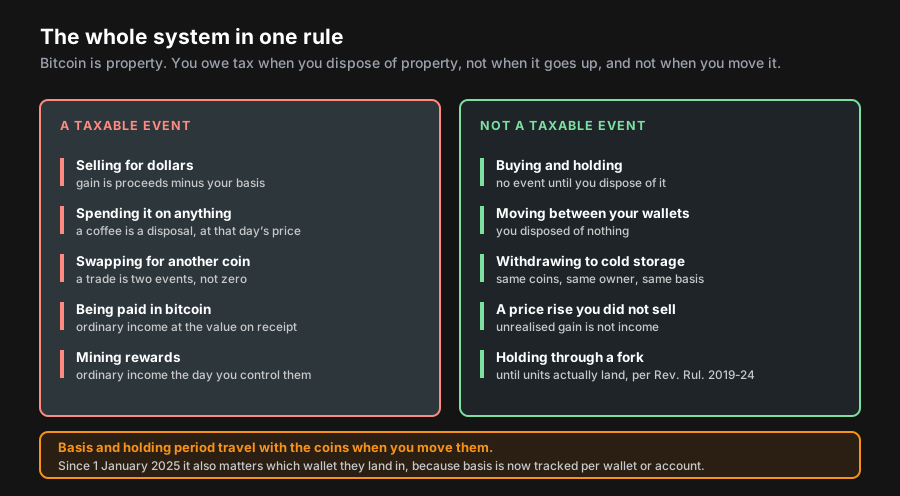
The IRS treats Bitcoin as property, not currency. That one classification generates every rule that follows. You owe tax when you dispose of property, which means selling it, spending it, or trading it for something else. You owe nothing while you hold it, however far it moves, and nothing when you shift coins between wallets you own.
This is general information about how the US federal rules are written, not tax advice. It is not personalised to your situation and cannot be. Rules differ by state, by country and by circumstance, and the amounts here change every year with inflation. Take a real return to a CPA or an enrolled agent.
Why is Bitcoin taxed as property?
Because the IRS said so in 2014 and has never changed its mind. Notice 2014-21 opens with the holding that "for federal tax purposes, virtual currency is treated as property," and that general tax principles applicable to property transactions apply to it. The same notice closes off the alternative in Q-2: it is not treated as currency capable of generating foreign currency gain or loss.
That is not a technicality. Currency treatment would have meant no capital gains on spending it, which is why a euro in your pocket does not create a tax event when you buy lunch in Paris. Property treatment means every purchase you make in bitcoin is a sale of property at that day's price, followed by a purchase of the coffee. The coffee is not the problem. The record-keeping is.
Two consequences follow, and they are worth stating flatly because they surprise people. Spending bitcoin creates a taxable disposal even when you did not receive a dollar. And trading bitcoin for another digital asset is a disposal too, not a neutral shuffle, even if you never touched fiat.
Which actions are taxable, and which are not?
| What you did | Treatment | Measured how |
|---|---|---|
| Sold BTC for dollars | Capital gain or loss | Proceeds minus basis |
| Bought a laptop with BTC | Capital gain or loss | Value of the laptop minus basis |
| Swapped BTC for another coin | Capital gain or loss | Value received minus basis |
| Got paid in BTC for work | Ordinary income | Fair market value on receipt |
| Mined a block reward | Ordinary income | Fair market value on receipt |
| Bought BTC and held it | Nothing yet | Basis is what you paid |
| Moved BTC to a hardware wallet | Nothing | Basis and holding period follow it |
| Watched the price double | Nothing | Unrealised gain is not income |
| Gave BTC to a friend | No income tax to you | Form 709 above the annual exclusion |
The double-counting worry is the most common question here, and the answer is that it does not happen. If you were paid 0.1 BTC worth $6,000, you declare $6,000 of ordinary income and your basis in those coins becomes $6,000. Sell them later at $8,000 and your capital gain is $2,000, not $8,000. Notice 2014-21 Q-4 says this directly: basis is the fair market value in US dollars as of the date of receipt.
How long you held it decides the rate
The threshold is more than one year. Hold longer than that and the gain is long-term, taxed at 0, 15 or 20 percent depending on your total taxable income. Hold a year or less and it is short-term, taxed as ordinary income at whatever your marginal rate happens to be. For a higher earner that gap is roughly twenty percentage points on the same profit, which makes the holding period one of the few genuinely large levers an ordinary holder has.
| Rate | Filing status | Tax year 2025 | Tax year 2026 |
|---|---|---|---|
| 0% up to | Single | $48,350 | $49,450 |
| Married filing jointly | $96,700 | $98,900 | |
| Head of household | $64,750 | $66,200 | |
| 15% up to | Single | $533,400 | $545,500 |
| Married filing jointly | $600,050 | $613,700 | |
| Head of household | $566,700 | $579,600 | |
| 20% | All | Taxable income above the 15% threshold | |
How losses actually work
Losses are useful and badly underused, mostly because people stop reporting once a year goes against them. The mechanics are generous. Capital losses offset capital gains without any limit at all, so a bad trade and a good one in the same year cancel down to the net. Only after gains are exhausted does the cap appear, and then you may deduct the lesser of $3,000, or $1,500 if married filing separately, against ordinary income.
Whatever is left carries forward indefinitely. That word matters. A $40,000 net loss does not evaporate; it sits there reducing future gains for as long as it takes, which for a Bitcoin holder through one full cycle can be worth a great deal. The catch is that a carryforward only exists if you filed the return that created it. A loss you never reported is a deduction you gave away, and you cannot retroactively invent it years later when you finally have gains to offset.
What if you have no records?
This is the most common real-world situation and the one guides skip, so here it is plainly. The burden of substantiating cost basis falls on the taxpayer. Basis you cannot support is, in practice, basis of zero, and basis of zero means the entire sale price is gain. That is how someone who genuinely made $8,000 ends up assessed on $40,000.
Reconstruction is usually possible and worth the weekend. Exchange accounts can export full transaction history, often further back than the dashboard displays. On-chain activity is permanent and public, so a block explorer will show you every deposit and withdrawal to an address you controlled, with dates. Historical daily prices are widely published, and Notice 2014-21 Q-5 accepts a rate from an exchange where the rate is set by market supply and demand, applied "in a reasonable manner that is consistently applied." Reasonable and consistent is the standard, not perfection.
| Source | What it gives you | Limit |
|---|---|---|
| Exchange CSV export | Dates, amounts and the price you paid | That platform only, and it dies with the platform |
| Block explorer plus your addresses | Every deposit and withdrawal, with dates | Shows amounts and timing, never what they cost |
| Bank and card statements | The dollar side of a purchase | Ties an amount to a date, not to a specific lot |
| Published daily price history | Fair market value on a given date | Must be applied reasonably and consistently |
| Your own emails and receipts | Order confirmations, transfer notices | Usually the strongest evidence you actually have |
What you are building is a documented estimate you could hand to an agent and defend line by line: date acquired, amount, dollar value, source, and the wallet it landed in. That is a materially different thing from a number you made up, even if the two happen to be close. Do the work while the exchange still exists, because a closed platform takes its export function with it.
The basis rule almost nobody noticed
This is the change that matters most and got the least attention, so if you read one section, read this one.
For years, most holders and most software treated cost basis as a single universal pool. All your bitcoin, everywhere, in one queue. Sell from your phone wallet and the software would pick a lot you had bought on an exchange years earlier. Revenue Procedure 2024-28 ended that. Basis is now allocated to a specific wallet or account, and holders had to allocate any unattached basis to specific wallets and accounts as of 1 January 2025, using a reasonable method based on their own records.
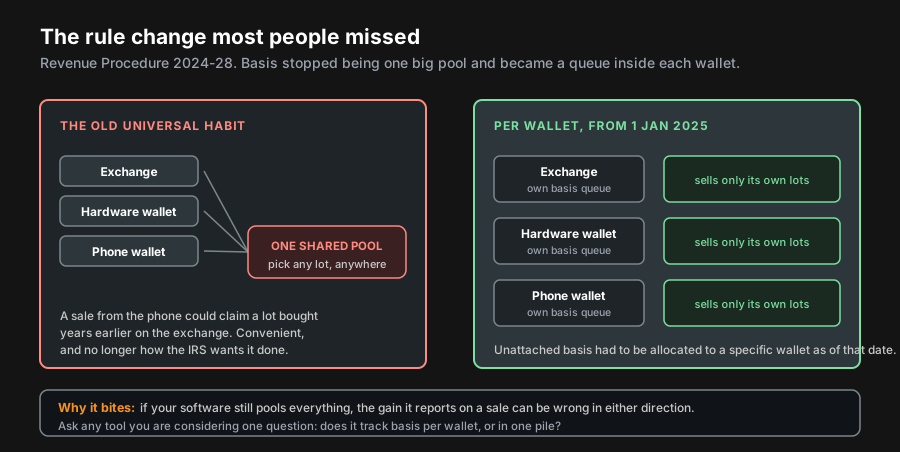
If you self-custody, this has a consequence that is easy to miss. Every hardware wallet, every mobile wallet, every exchange account is now its own bucket. Moving coins between them is still not a taxable event, but the basis moves with the coins and lands in the destination bucket. Keeping a clean record of what went where is no longer bookkeeping hygiene, it is the input to the calculation.
What is Form 1099-DA and when does it apply?
It is the broker information return for digital assets, created by regulations finalised on 9 July 2024, and it arrived in two stages that are frequently confused.
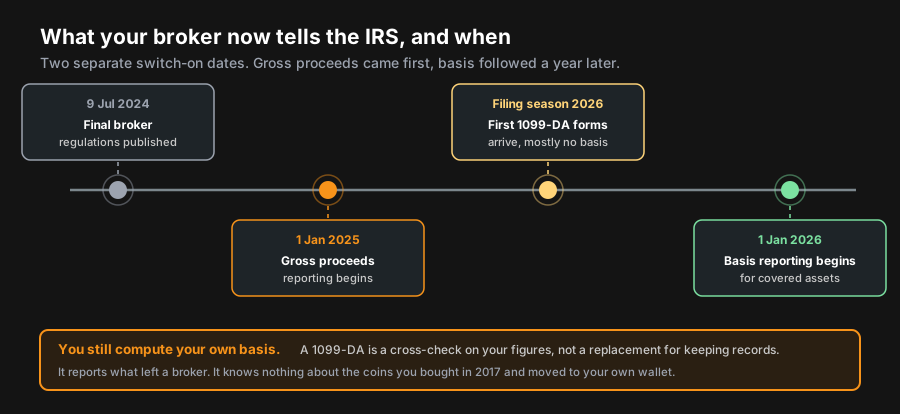
Brokers report gross proceeds for transactions effected on or after 1 January 2025, and basis for certain transactions effected on or after 1 January 2026. So the forms covering 2025, which reached taxpayers during the 2026 filing season, mostly showed what a sale brought in and said nothing about what the coins had cost. The IRS also granted transition relief for 2025, declining to impose penalties where a broker made a good faith effort to file and furnish the forms correctly and on time.
Two things follow. First, if a 1099-DA reported $40,000 of proceeds and you did nothing, the assumption sitting in front of the IRS is a $40,000 gain. Your basis is the only thing that reduces it, and supplying it is your job. Second, a broker only knows what happened on its own platform. Coins you bought in 2018 and withdrew to a hardware wallet are invisible to it. Treat the form as a cross-check on your own records, never as a substitute for them.
Mining, forks and airdrops
Mining is income at the moment you receive it. Notice 2014-21 Q-8 puts the fair market value of mined coins in gross income as of the date of receipt, and Q-9 adds that if the mining amounts to a trade or business, the net earnings are self-employment income subject to self-employment tax. That second part catches people who treated a serious operation as a hobby. If you are weighing the economics, our piece on mining profitability in 2026 covers the pre-tax side.
Forks and airdrops are governed by Revenue Ruling 2019-24, and its logic is cleaner than its reputation. A hard fork alone produces no income if you receive no units of a new cryptocurrency. Receive units through an airdrop following a hard fork and you have ordinary income. The hinge is dominion and control: you have income when you can actually transfer, sell or otherwise dispose of the coins. If your exchange did not support the new asset, you had not received it yet, and receipt happens later when you gain the ability to move it.
| Event | Income arises | Amount | What follows |
|---|---|---|---|
| Paid in BTC for work | On receipt | Fair market value that day | Basis equals the income declared |
| Mined block reward | On receipt | Fair market value that day | Self-employment tax if a trade or business |
| Airdrop after a hard fork | When you have dominion and control | Value at that moment | Ordinary income, then a new capital asset |
| Hard fork, no units received | Never | None | No event at all |
| Fork your exchange did not support | Later, when you can move it | Value when support arrives | Receipt is deferred, not skipped |
Do wash sale rules apply to Bitcoin?
Section 1091 disallows a loss where you reacquire "substantially identical stock or securities" within a window running from 30 days before the sale to 30 days after it. Read the words: the statute applies to shares of stock or securities. Notice 2014-21 classifies digital assets as property, and the IRS has not published guidance extending section 1091 to them.
So the common understanding is that a Bitcoin holder can realise a loss and buy back immediately. We would add two cautions rather than a recommendation. Proposals to extend the wash sale rule to digital assets have been raised in Congress more than once, so this is a current state rather than a settled principle. And a transaction whose only purpose is a tax deduction can attract scrutiny on other grounds entirely. Anyone planning around this should get an opinion from someone who will sign the return.
Which forms do you actually file?
| What happened | Where it goes | Note |
|---|---|---|
| Sold, spent or swapped | Form 8949, carried to Schedule D | Short-term and long-term listed separately |
| Mining, staking or airdrop income | Schedule 1 | Ordinary income at value on receipt |
| Mining as a trade or business | Schedule C | Self-employment tax may apply |
| Gift above the annual exclusion | Form 709 | $19,000 per recipient for 2026 |
| Any digital asset activity at all | The question on Form 1040 | Answered yes or no, every year |
What Bitcoin tax software actually has to do
Most of these tools were built to import exchange history, and self-custody is where they diverge in quality. Rather than rank vendors whose feature sets change quarterly, here is the checklist to test any of them against, with the rule that creates each requirement. Run your own data through a trial and check the output before you pay.
| It must | Because |
|---|---|
| Track basis per wallet or account, not one universal pool | Rev. Proc. 2024-28, effective 1 January 2025 |
| Import on-chain addresses or an xpub, not only exchange API keys | Self-custodied coins never appear on a broker's records |
| Recognise a self-transfer and not book it as a sale | Moving between your own wallets is not a disposal |
| Carry the original acquisition date through a transfer | The one-year holding period decides the rate |
| Separate ordinary income from capital gains, with income setting basis | Notice 2014-21 Q-3, Q-4 and Q-8 |
| Emit a Form 8949 your preparer can actually use | That is where every disposal is reported |
| Reconcile against a 1099-DA line by line | Proceeds since 2025, basis since 2026 |
| Apply one identification method consistently and show its working | You have to be able to defend the figure |
Whatever tool you pick, keep your own records anyway: acquisition date, amount, dollar value at the time, which wallet, and the transaction ID. A block explorer can reconstruct the on-chain half years later, but only your own notes reconstruct what a coin cost you.
One scoping note. This guide is about Bitcoin. The IRS rules described here apply to digital assets generally, but the practical details differ enough by asset that we cover Dogecoin separately on our sister site, dogemint.com. If you hold a spot ETF rather than coins, the reporting path is different again and runs through an ordinary brokerage 1099-B, which our guide to spot Bitcoin ETFs touches on.
The habit worth building is unglamorous. Record every acquisition when it happens, in dollars, with the date and the wallet. Reconstructing five years of that in April, from exchange exports and a memory, is how people end up paying tax on gains they never made.
Related on BTCLinks
Sources
- IRS Notice 2014-21, Internal Revenue Bulletin 2014-16. Source of the property holding in Q-1, the not-a-currency holding in Q-2, income on receipt in Q-3, basis equal to fair market value on receipt in Q-4, gain on exchange in Q-6, mining income in Q-8 and self-employment tax in Q-9. Verified 2026-07-29.
- IRS Revenue Ruling 2019-24, Internal Revenue Bulletin 2019-44. Source of the hard fork and airdrop holdings and the dominion and control test. Verified 2026-07-29.
- IRS Revenue Procedure 2024-28, Internal Revenue Bulletin 2024-31. Source of the allocation of unattached basis to a specific wallet or account as of 1 January 2025, and the reasonable-allocation standard. Verified 2026-07-29.
- IRS: Digital assets. Source of the property statement, the Form 1040 digital asset question wording, the Form 8949, Schedule D, Schedule 1, Schedule C and Form 709 reporting paths, and the 1099-DA dates of 1 January 2025 for gross proceeds and 1 January 2026 for basis. Verified 2026-07-29.
- IRS: Frequently asked questions about broker reporting. Source of the 2025 transition relief for good faith filing and the note that most 2025 statements carry no basis. Verified 2026-07-29.
- IRS Topic no. 409, Capital gains and losses. Source of the more-than-one-year holding period, the 2025 rate thresholds, and the $3,000 and $1,500 loss limits with indefinite carryover. Verified 2026-07-29.
- IRS Revenue Procedure 2025-32, Internal Revenue Bulletin 2025-45. Source of the tax year 2026 capital gains thresholds and the $19,000 annual gift exclusion. Verified 2026-07-29.
- 26 U.S.C. section 1091. The wash sale statute, whose text applies to "shares of stock or securities" within 30 days before or after a sale. Verified 2026-07-29.
General information only, not tax, legal or financial advice. Figures are US federal and change annually. Some links on this site are affiliate links. As an Amazon Associate we earn from qualifying purchases.