Bitcoin Inheritance Planning: Passing Down Your Keys
The single most important rule in this whole subject is a negative one: your seed phrase must never appear in your will. A will is a private document right up until the moment it stops being one, and that moment is probate, when it becomes a court record that anyone can request and read.
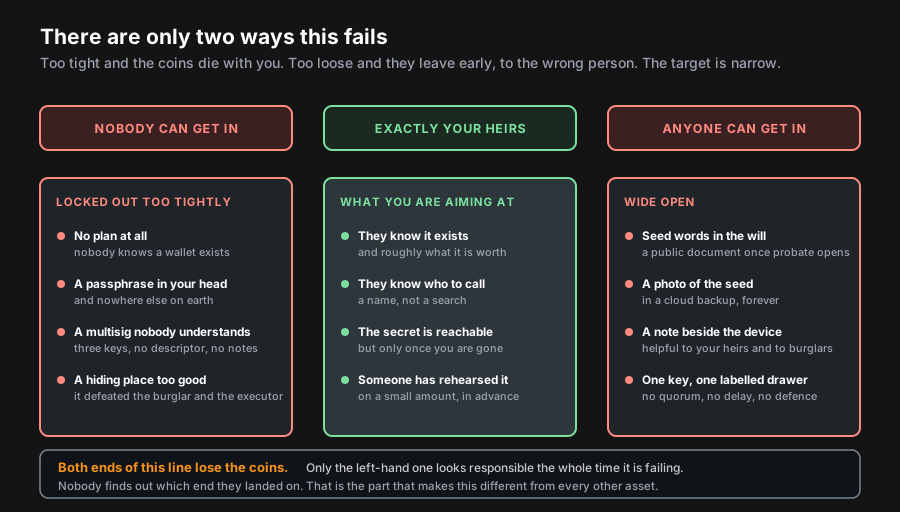
The plan you want does two things at once. It makes the keys reachable by exactly the people who should have them, at exactly the point they should have them, and by nobody else before then. Every failure in this area is a failure of one of those two halves, and the sad part is that the tighter half fails silently.
Why does a seed phrase never belong in a will?
Because a will is a filing, and filings are public. New York's court system states it about as plainly as it can be stated: "Wills are a confidential document until someone dies. Once the Will is admitted to probate or a small estate, it becomes a public document that anyone can see and read."
Sit with what that means for twenty-four words. Probate can run for months. During that time the document is accessible to court staff, to attorneys for anyone with an interest, to any beneficiary and their family, and in many jurisdictions to any member of the public who asks or searches an online index. Your heirs may be scrupulous. The plan has to survive people who are not, and it has to survive them having months of unsupervised access to a document that spends the coins.
The exact mechanics vary by state and by country, and some jurisdictions restrict access more than others. That variation is a reason to be more careful, not less. The rule that works everywhere is simple: a will may say where something is, never what it says.
The same reasoning rules out a few adjacent ideas that come up. Do not put the words in a trust document that gets filed. Do not email them to your attorney. Do not photograph the steel plate "just as a backup," because that photograph is now in a cloud account with a password reset flow attached to a phone number.
What can a will safely contain?
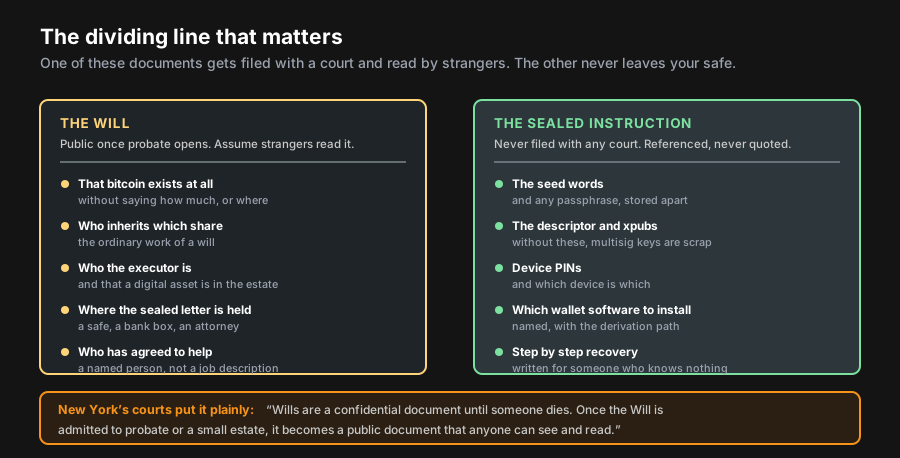
Notice what is missing from the left panel. Not the amount, because a public document naming a large sum turns your heirs into targets. Not the address of the building where keys are stored. A pointer like "a sealed letter held by my attorney" is enough for an executor to act on and useless to anyone else.
One thing worth adding that people forget: name a specific human being who has agreed to help. Not "a Bitcoin expert," which is an instruction to go and find a stranger on the internet during a bereavement. A named person, who knows they are named, and who has some idea what your setup is.
Writing the sealed instruction
This is the document that does the actual work, and it is worth more effort than the will. Write it for a specific person who has never opened a wallet. Assume no jargon lands.
- Start with orientation, not instructions. One paragraph on what Bitcoin is, that these coins are real property with real value, and that following the steps in order matters more than understanding them.
- The words, and where the other pieces are. Seed phrase, passphrase if you use one, stored in a different place from the words themselves.
- The descriptor and extended public keys if this is a multisig wallet. Without that string, every key you left behind is a piece of stamped metal.
- Named software, and the derivation path. "Install Sparrow Wallet, choose restore, enter the words, set the derivation path to this." A wallet restored on the wrong path shows a balance of zero and looks exactly like theft.
- A warning about the scams that target this moment. Anyone who offers to help recover a wallet in exchange for the seed phrase is stealing it. Our guide to common scams exists partly for this reader.
- A date, and a note on what to re-check. Wallet software changes names and owners. A five-year-old instruction naming dead software is a dead instruction.
| If the letter omits | What your heir experiences |
|---|---|
| The seed words | Nothing else on this list matters. |
| The passphrase | The words open a real wallet showing zero. No error, no clue. |
| The descriptor or xpubs | A multisig cannot be rebuilt. Every key is scrap. |
| The wallet software, by name | They guess, and guess wrong on the derivation path. |
| The derivation path | A restored wallet shows zero and looks exactly like theft. |
| Device PINs | Repeated guesses wipe the device. |
| A dated review note | They install software that was renamed or abandoned years ago. |
Store it somewhere that resists both fire and curiosity. A tamper-evident envelope inside a home safe tells you whether it has been opened, which is worth knowing: numbered tamper-evident security bags on Amazon. A bank box is fine too, with one caveat worth checking in your jurisdiction: access to a box can be frozen at death until an executor is formally appointed, which may be exactly when your family needs it.
Where does multisig fit?
It solves the specific problem that a single seed phrase cannot: how to give someone the ability to help without giving them the ability to steal.
In a 2-of-3, you might hold two keys and an attorney or a trusted family member hold the third. That third key does nothing on its own. It cannot move a satoshi, so handing it over costs you nothing today. After your death, your executor combines it with one of your two keys, recovered from your safe, and the balance is reachable. Meanwhile, a burglar who finds one of your keys has found nothing.
| Party | Holds | Can do alone today | After your death |
|---|---|---|---|
| You | Keys A and B, the descriptor | Everything | Nothing, obviously |
| Trusted holder attorney or family | Key C, a descriptor copy | Nothing | Combines with A or B from your safe |
| Executor | The will, which names the sealed letter | Nothing | Retrieves a key and the instructions |
| A burglar | Whatever was in one building | Nothing | Still nothing |
| Anyone reading probate records | The will's text | Nothing | Nothing, if you followed the rule above |
The catch is the same catch as always, and it is worth repeating because it is the leading cause of failed multisig recoveries. The keys are not the wallet. The descriptor is the record of which public keys form the wallet and what quorum they need, and without it no software on earth can reconstruct your addresses. Put the descriptor in the sealed instruction, and put a copy with every key you distribute.
Be honest with yourself about who is going to operate this. A 2-of-3 across three cities is excellent security and a genuinely difficult thing for a grieving non-technical spouse to execute from written instructions. If nobody in your household can run it, the plan needs a named person who can, or it needs to be simpler.
Can a timelock act as a dead man's switch?
Yes, and this is the most elegant approach available, with one ceiling that catches people out.
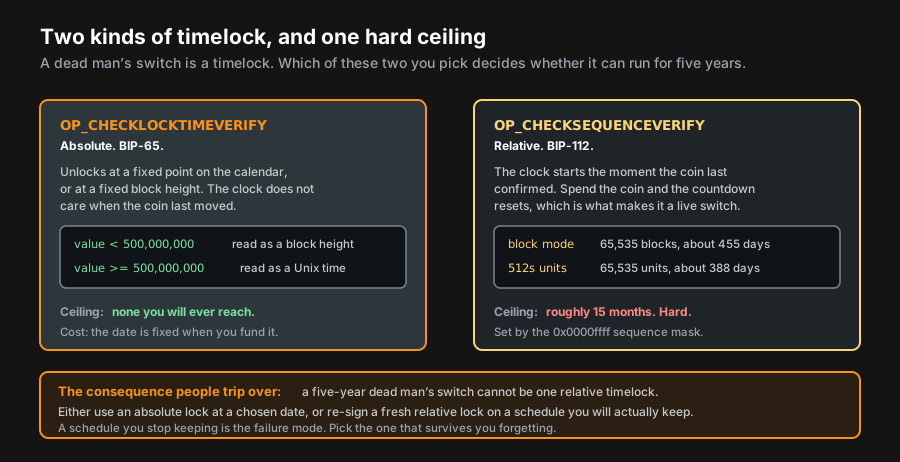
The arrangement usually looks like this: your key can spend at any time, and a second key belonging to your heir can spend only after a period of inactivity. While you are alive you move the coins occasionally, which resets the clock and keeps the heir's path closed. Stop moving them, for the obvious reason, and the path opens on its own with no lawyer, no court and no cooperation from anyone.
That behaviour comes from OP_CHECKSEQUENCEVERIFY, the relative timelock in BIP-112, whose clock starts when the coin last confirmed. The ceiling comes from the same place: the sequence lock-time mask is 0x0000ffff, so the maximum is 65,535 units, which is roughly 455 days counting blocks or about 388 days counting 512-second intervals. Just over a year, and no more.
So a switch that should wait five years cannot be a single relative timelock. Either use OP_CHECKLOCKTIMEVERIFY from BIP-65, which is absolute and has no ceiling worth worrying about, or accept that you must re-sign a fresh lock roughly once a year. BIP-65's own worked example is essentially this arrangement: funds spendable by two parties at any time, with a lawyer's path opening after three months. The design has been in the protocol since 2015.
Be clear-eyed about the trade. An absolute lock fixed at a date is set in stone the moment you fund it, and if you outlive it the heir's path opens while you are alive. A relative lock stays correct forever but depends on you performing a maintenance transaction on a schedule you may stop keeping. Pick the one that survives the way you actually behave, not the way you intend to.
Comparing the options honestly
| Approach | Cost | Complexity for heirs | How it fails |
|---|---|---|---|
| No plan | free | impossible | Coins are lost. This is the default outcome. |
| Seed in the will | free | trivial | Public at probate. Trivial for anyone, not just heirs. |
| Sealed letter of instruction | near zero | low | Letter is lost, found early, or names dead software. |
| Sealed letter plus attorney | legal fees | low | Attorney retires and the file goes nobody knows where. |
| 2-of-3 multisig with a trusted holder | device costs | moderate | Descriptor never backed up, or nobody can operate it. |
| Timelocked recovery path | setup effort | low once it fires | Relative locks need re-signing; absolute ones can fire early. |
| Collaborative custody service | subscription | lowest | Provider dependency, and you never tested recovery. |
What about coins on an exchange?
Different problem, different law, and this is where a will genuinely does help.
Most US states have enacted a version of the Revised Uniform Fiduciary Access to Digital Assets Act, which governs how a custodian discloses digital assets to a fiduciary. Washington's enactment shows the priority order clearly. A direction given through the custodian's own online tool wins: the statute says a direction using an online tool "overrides a contrary direction by the user in a will, trust, power of attorney, or other record." Where no online tool was used or offered, the will, trust or power of attorney controls. And a user direction under either route overrides a contrary term in a terms-of-service agreement the user never separately agreed to.
Two practical takeaways. If your exchange offers a beneficiary or legacy-contact setting, that setting beats your will, so set it and make sure it agrees with your estate documents. And check your own state's version, because the details and the procedure differ.
Now the important limit. All of this is machinery for ordering a custodian to hand something over. Coins in your own hardware wallet have no custodian. There is no company to serve with a court order and no account to recover. A judge can award your heirs the bitcoin and be entirely unable to deliver it, which is the whole reason this article exists. The distinction between the two situations is the subject of our guide to custodial and non-custodial wallets.
What happens to cost basis at death?
Better than most people expect, at least on the federal calculation. Under 26 U.S.C. section 1014, the basis of property acquired from a decedent is generally "the fair market value of the property at the date of the decedent's death." Coins bought at $400 and inherited at $60,000 arrive in your heir's hands with a basis of $60,000, so selling promptly produces little or no capital gain.
| Item | Rule or figure | Source |
|---|---|---|
| Basis of inherited property | Fair market value at date of death | 26 U.S.C. 1014(a)(1) |
| Estate basic exclusion, 2026 deaths | $15,000,000 | Rev. Proc. 2025-32 |
| Estate basic exclusion, 2025 deaths | $13,990,000 | Rev. Proc. 2025-32 |
| Annual gift exclusion, 2026 | $19,000 per recipient | Rev. Proc. 2025-32 |
| Gifts above that | Reported on Form 709 | IRS digital assets guidance |
One consequence worth flagging, without turning it into advice: gifting appreciated coins during your lifetime and leaving them in your estate produce different basis outcomes for the recipient. Which is preferable depends on facts this article cannot know. The general shape of Bitcoin tax treatment is covered in our guide to Bitcoin and taxes, and the specific decision belongs with an estate attorney and a CPA in your state.
The only test that matters
Everything above is a design. This is how you find out whether you built it.
Take a small amount of bitcoin, a few dollars' worth. Hand your heir the sealed instruction and leave the room. No hints, no hovering, no answering questions. Let them install the software, restore the wallet, and send the coins somewhere. Then read their notes on where they got stuck, and fix the document rather than the person.
Most plans fail this the first time, and they fail in dull, fixable ways. The software has been renamed. The derivation path was assumed rather than written. The instruction says "enter your passphrase" without saying where it is. Nobody knew the safe combination. Every one of these is trivial to correct on a Tuesday afternoon and catastrophic to discover in the real event, because in the real event there is nobody left to ask.
Then put a recurring reminder in your calendar to reread the whole thing once a year. Wallets get discontinued, people move, attorneys retire, and the plan that was correct in 2026 quietly stops being correct. An inheritance plan is not a document you finish. It is one you maintain, and the maintenance is fifteen minutes a year.
Related on BTCLinks
Sources
- New York State Courts, Ask a Law Librarian: How can I access my loved one's will?. Source of the quoted statement that a will is confidential until death and becomes a public document at probate. Verified 2026-07-29.
- 26 U.S.C. section 1014, Basis of property acquired from a decedent. Source of the general rule that basis is the fair market value at the date of the decedent's death. Verified 2026-07-29.
- IRS: Tax inflation adjustments for tax year 2026 (Rev. Proc. 2025-32). Source of the $15,000,000 basic exclusion for 2026 decedents, the $13,990,000 figure for 2025, and the $19,000 annual gift exclusion. Verified 2026-07-29.
- BIP-65: OP_CHECKLOCKTIMEVERIFY. Source of the absolute timelock behaviour, the 500,000,000 threshold separating block height from Unix time, and the escrow example with a third-party path opening after three months. Verified 2026-07-29.
- BIP-112: CHECKSEQUENCEVERIFY. Source of the relative timelock behaviour, the 512-second unit, and
SEQUENCE_LOCKTIME_MASK = 0x0000ffff, from which the 65,535-unit ceiling and the 455-day and 388-day limits follow. Verified 2026-07-29. - RCW 11.120.040, Washington's enactment of the Revised Uniform Fiduciary Access to Digital Assets Act. Source of the priority order quoted: online tool over will, will where no online tool was used, and user direction over a contrary terms-of-service provision. RCW 11.120.030 sets the scope, which is limited to custodians. Other states differ. Verified 2026-07-29.
- Uniform Law Commission: Fiduciary Access to Digital Assets Act, Revised. The model act that states have enacted in varying forms. Verified 2026-07-29.
- Bitcoin Core: Support for Output Descriptors. Source for the role of the descriptor in reconstructing a multisig wallet. Verified 2026-07-29.
General information, not legal or tax advice. Estate law and probate procedure differ by state and by country; take a real plan to an attorney licensed where you live. Some links are affiliate links. As an Amazon Associate we earn from qualifying purchases.