Bitcoin Layer 2: Lightning, Liquid, and What's Next
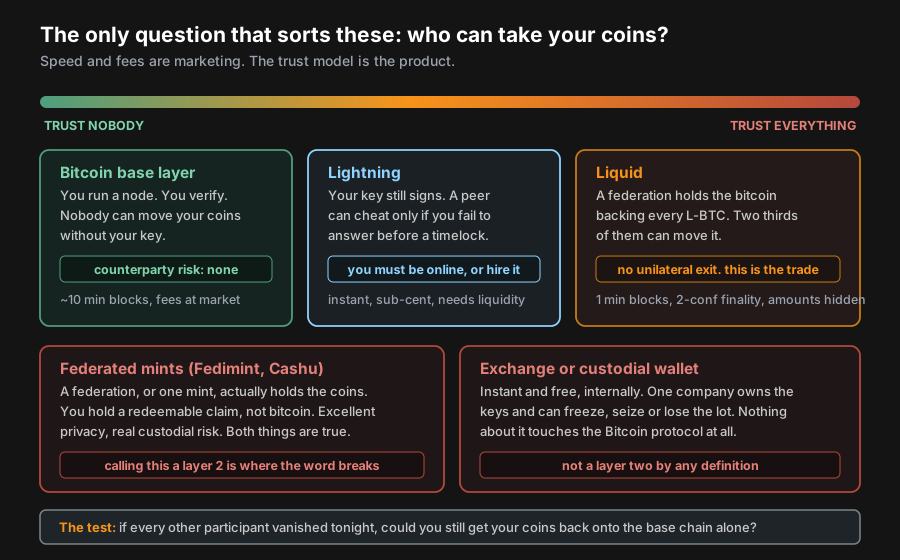
There is one question that sorts every Bitcoin scaling system, and it is not about speed or fees. It is this: if every other participant disappeared tonight, could you still get your coins back onto the base chain by yourself? Lightning passes that test. Liquid does not. Neither does anything custodial, whatever it calls itself.
"Layer 2" gets applied to all of them anyway, which is why the term has stopped carrying information. Sorting by trust model instead of by marketing makes the comparison honest, and it turns out to be the only comparison that matters when something goes wrong.
What counts as a layer 2 at all?
There is no formal definition, which is exactly how the word got so slippery. A workable one has two parts: the system must settle to Bitcoin, and it must let a participant exit to Bitcoin without anyone's permission.
The second half does the work. Plenty of things settle to Bitcoin eventually. Far fewer let you leave when the operator stops answering the phone, and that is the property you actually care about at the exact moment you care about anything.
By that test, Lightning is a layer 2. A federated sidechain is a sidechain, which is a real and useful category with a real and different risk profile. An exchange balance is a database entry. Calling all three "layer 2" flattens a distinction that is the entire point.
Lightning: the one that passes the test
Two parties lock coins in a shared output on the base chain, then trade signed updates that redistribute the balance between them. Only two transactions ever need to hit the chain, the one that opens the channel and the one that closes it. Everything between is off chain and effectively free.
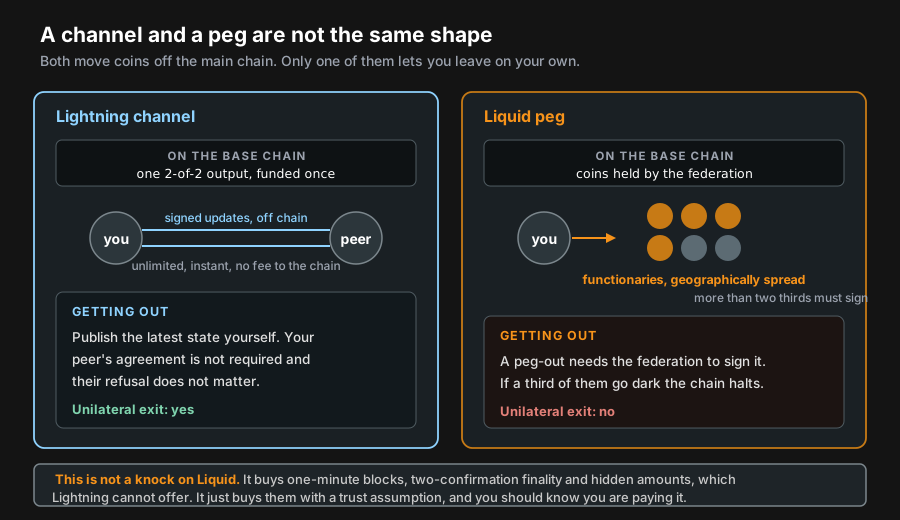
The security comes from the closing rules. Publish an old, more favourable state and your counterparty has a window to take the entire channel balance as a penalty. Cheating is therefore not merely detectable, it is punished, provided somebody is watching. That proviso is Lightning's real cost: you have to be online during the timelock window, or pay a watchtower to be online for you.
What Lightning is genuinely good at: small payments, instantly, for a fraction of a cent, with better privacy than an on-chain payment because the intermediate hops are not published anywhere. What it is bad at: receiving money you did not plan for, because inbound liquidity has to exist before somebody can pay you. Our Lightning guide goes through the liquidity problem properly, since it is the thing that confuses almost every newcomer.
One honest note on the statistics, because they get quoted carelessly. Public capacity is estimated by crawling the gossip graph, and different crawlers see different subsets of it. On 29 July 2026, 1ML reported 21,217 channels and 2,815.48 BTC of public capacity, with an average channel of 0.132 BTC. Other trackers reported considerably more over the same period. Neither is lying; they see different slices, and private channels appear in nobody's total by design. Any single Lightning capacity number is one crawler's view.
| Measure | 1ML, 29 July 2026 | What it misses |
|---|---|---|
| Public channels | 21,217 | Every private channel, by design |
| Public capacity | 2,815.48 BTC | Nodes this crawler never reached |
| Average channel | 0.132 BTC | Skewed by many tiny mobile channels |
| Average channels per node | 6.76 | Hides how concentrated routing really is |
The direction of travel is easier to state than the totals. Capacity has concentrated into fewer, larger, better-run nodes, which makes payments more reliable and makes the routing graph less distributed than the early promise implied. That is a real trade-off and worth watching, though it is not the same failure as custody: a well-connected routing node still cannot take the coins in your channel.
Liquid: fast, private, and federated
Liquid is a sidechain. Bitcoin is locked on the main chain and an equivalent amount of L-BTC appears on a separate chain with its own rules, its own blocks, and its own assets. It is not a payment-channel network and it does not work like one.
The consensus is what Blockstream calls a Strong Federation. Functionaries, drawn from exchanges, financial institutions and Bitcoin companies, each play two roles: block signer and watchman. Blocks require signatures from at least two thirds of block signers, and the watchmen "require a greater than two-thirds threshold to spend funds in the Liquid Network". Blocks come every minute, and transactions are considered final after two confirmations, so settlement runs two to three minutes.
How much is actually on it? Reading the L-BTC record from Blockstream's own Liquid explorer on 29 July 2026: 17,295.43 BTC pegged in across 114,066 peg-ins, 13,058.42 BTC pegged out across 9,802 peg-outs, and 10.03 BTC burned. That leaves about 4,227 BTC circulating. Real usage, and a small fraction of one percent of the supply.
| Measure | Value | Count |
|---|---|---|
| Pegged in from Bitcoin | 17,295.43 BTC | 114,066 peg-ins |
| Pegged out to Bitcoin | 13,058.42 BTC | 9,802 peg-outs |
| Burned | 10.03 BTC | 987 burns |
| Circulating as L-BTC | 4,226.98 BTC | 124,810 asset transactions |
The failure mode is stated plainly in the same documentation: if one third or more of the functionaries stop operating, the network freezes until at least two thirds come back online. Your coins are not stolen in that scenario. They are simply not moving until enough institutions return.
It is worth being precise about what that federation can and cannot do, because "federated" gets used as a slur when it is really a specification. The functionaries cannot inflate L-BTC, because every unit is backed by bitcoin they are jointly holding and the peg is auditable on the main chain. They cannot individually run off with anything, because no single member holds a spendable key. What a two-thirds majority could do, in principle, is move the backing funds or refuse to process a peg-out. That is a smaller risk than a custodial exchange and a categorically larger one than holding your own keys.
The membership is also a genuine part of the security model rather than a footnote. Blockstream describes the functionaries as members drawn from large exchanges, financial institutions and Bitcoin-focused companies, geographically distributed. The bet is that a quorum of competing businesses in different jurisdictions will not collude, and that any one of them defecting has more to lose commercially than it could gain. That is a reasonable bet. It is still a bet, and it is a different kind of assumption from the one securing the base chain, which asks you to trust arithmetic instead of incentives.
What you get for that trust is real and Lightning cannot offer it. Confidential Transactions hide amounts and asset types from everyone except the parties involved, which is a genuinely different privacy property from anything on the base chain. Issued assets work natively, which is why stablecoins and security tokens ended up there. And one-minute blocks with two-confirmation finality suit exchange-to-exchange settlement in a way ten-minute probabilistic confirmation does not.
| Lightning | Liquid | Federated mint | Custodian | |
|---|---|---|---|---|
| Unilateral exit | Yes | No | No | No |
| Who can move your coins | Only you | Two thirds of functionaries | The federation | The company |
| Settlement | Instant | 2 confirmations, 2 to 3 min | Instant | Instant, internal only |
| Amounts visible? | Not publicly | Hidden by Confidential Transactions | Not publicly | To the company |
| You must be online? | Yes, or use a watchtower | No | No | No |
| Worst realistic case | Force-close, pay a fee, wait | Chain halts until quorum returns | Federation loses or takes funds | Total loss |
| Honest label | Layer 2 | Sidechain | Custodial with good privacy | A bank |
Federated mints, and why the category matters
Fedimint and Cashu implement Chaumian ecash on top of Bitcoin. A mint issues blinded tokens backed by bitcoin it holds, and because the tokens are blinded the mint cannot see who spent what. The privacy is excellent, better than anything else on this page.
The mint also holds your coins. Fedimint spreads that across a federation, usually a group who already know each other, which reduces the risk of any one member absconding without removing the category of risk. Cashu mints are typically operated by one party.
| Fedimint | Cashu | |
|---|---|---|
| Who holds the bitcoin | A federation, by threshold | Typically a single mint |
| Can the holder see your payments? | No, tokens are blinded | No, tokens are blinded |
| If the holder vanishes | Funds lost unless a quorum remains | Funds lost |
| Best used for | Community-scale amounts | Pocket money and tips |
| Honest one-word summary | Custodial | Custodial |
These are worth understanding rather than dismissing, because they are honest about the trade and they solve a real problem: custody is genuinely hard, and a community mint run by people you actually know may be a better answer for small amounts than a beginner managing keys badly. Where it goes wrong is when the trade gets described as trustless. It is not, and the projects themselves generally say so more clearly than their fans do. If you are weighing this kind of thing up, our piece on custodial versus non-custodial wallets covers the same decision in a more familiar setting.
What is actually coming, and what is only proposed
This is where writing about Bitcoin scaling goes wrong most often, because roadmaps present ideas at wildly different stages of reality as though they were one list.
Covenant proposals. Most ambitious designs, including the interesting ones, need Bitcoin to gain some ability for an output to constrain how it is later spent. BIP-119, CHECKTEMPLATEVERIFY, carries the status Draft. BIP-347, OP_CAT in tapscript, reads Complete, which describes the document and not the network. Neither is active. Anything downstream of them is downstream of a soft fork nobody has scheduled.
Ark. A design for pooling many users' funds into shared outputs coordinated by an operator, aiming to fix Lightning's inbound-liquidity problem. Its documentation says users "always retain the ability to withdraw to Bitcoin L1 unilaterally, even if the operator goes offline," and that everything "runs on Bitcoin today with no protocol changes". It also relies on a single operator entity for coordination. We could not verify from its own documentation what the current mainnet deployment status is, and until unilateral exit has been demonstrated under real adversarial conditions rather than described, it belongs in the experimental column.
BitVM. A research direction for verifying arbitrary computation with Bitcoin script through fraud proofs. Genuinely clever, genuinely early, and not a place for money.
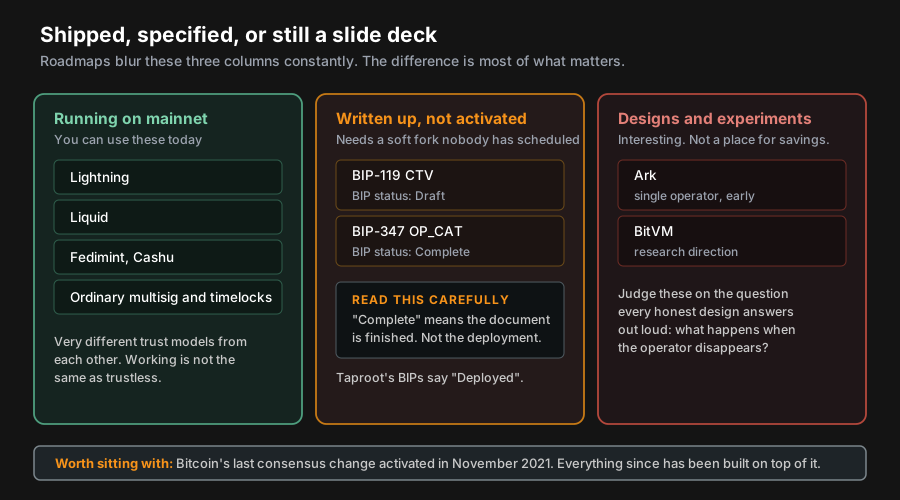
Now the fact that frames all of it: Bitcoin's last consensus change activated at block 709632 in November 2021. Nearly five years, no protocol change. Every scaling design that needs a new opcode is waiting in the same queue, and the queue has not moved. Whether you read that as admirable conservatism or as ossification is the argument underneath most Bitcoin development disputes, and the same fact is the best evidence for both.
Which one should you actually use?
Match the tool to the amount and the timeframe, and be suspicious of anything that wants to hold all of it.
- Savings you plan to keep for years. Base layer, in cold storage, ideally multisig above a threshold that would hurt to lose. No layer 2 improves this and every one of them adds a counterparty.
- Spending money and small payments. Lightning, holding only what you would carry in a wallet. The liquidity awkwardness is worth it and the amounts at risk are small by construction.
- Moving between exchanges, or handling issued assets. Liquid does this well and the federation risk is bounded by how briefly the funds sit there. Do not treat it as storage.
- Community-scale payments with strong privacy. A federated mint, for amounts you would lend to the people running it, because in effect that is what you are doing.
- Anything described as a Bitcoin layer 2 with a token. Read the exit path first. If nobody can tell you how to get your coins out unilaterally, you have your answer.
| Your situation | Use | Who has to cooperate to get it back |
|---|---|---|
| Long-term savings | Base layer, cold storage | Nobody |
| Everyday spending money | Lightning | Nobody, but you must respond within the timelock |
| Moving between exchanges | Liquid | Two thirds of the functionaries |
| Issued assets, confidential amounts | Liquid | Two thirds of the functionaries |
| Small community payments, high privacy | Federated mint | The federation, entirely |
| Anything experimental | Test amounts only | Unproven, which is the point |
The pattern worth internalising is that these are not competing products so much as different points on one trade. Every step away from the base chain buys speed or cost or privacy, and pays for it with somebody else's cooperation. That trade is often worth making. It is never free, and the marketing for these systems is uniformly built around the half of the trade that sounds good.
If you want one habit rather than a framework: before putting money into any of this, write down in a sentence who has to cooperate for you to get it back. If you cannot write that sentence, you have found the thing you did not understand yet.
Related on BTCLinks
Sources
- Liquid Network technical overview. Source of the Strong Federation model, the functionary block-signer and watchman roles, the requirement that blocks be signed by at least two thirds of block signers, the greater than two-thirds threshold to spend funds, the one-minute block time, two-confirmation finality, and the freeze behaviour when one third or more of functionaries go offline. Verified 2026-07-29.
- Blockstream Liquid explorer, L-BTC asset record. Source of the peg figures read on 29 July 2026: 17,295.43 BTC pegged in over 114,066 peg-ins, 13,058.42 BTC pegged out over 9,802 peg-outs, 10.03 BTC burned, leaving approximately 4,227 BTC circulating.
- 1ML Lightning Network statistics. Source of the 21,217 channels, 2,815.48 BTC capacity and 0.132 BTC average channel figures, read 2026-07-29. Quoted specifically as one crawler's view, not as a network measurement.
- BIP-119: CHECKTEMPLATEVERIFY. Status read as Draft, Layer Consensus (soft fork), from the specification header. Verified 2026-07-29.
- BIP-347: OP_CAT in Tapscript. Status read as Complete, Layer Consensus (soft fork). Verified 2026-07-29.
- BIP-341: Taproot. Confirms activation at block height 709632 and that no consensus deployment has followed it. Verified 2026-07-29.
- Arkade documentation. Source of the quoted claims that users retain the ability to withdraw to Bitcoin L1 unilaterally even if the operator goes offline, and that everything runs on Bitcoin today with no protocol changes. The documentation does not state a mainnet deployment status, which is why we describe Ark as experimental. Read 2026-07-29.
- Block 709632. Timestamp 14 November 2021, 05:15:27 UTC, confirming the date of the most recent Bitcoin consensus change. Verified 2026-07-29.
Some links are affiliate links. As an Amazon Associate we earn from qualifying purchases. Not financial advice.