Taproot Explained: Bitcoin's Biggest Upgrade
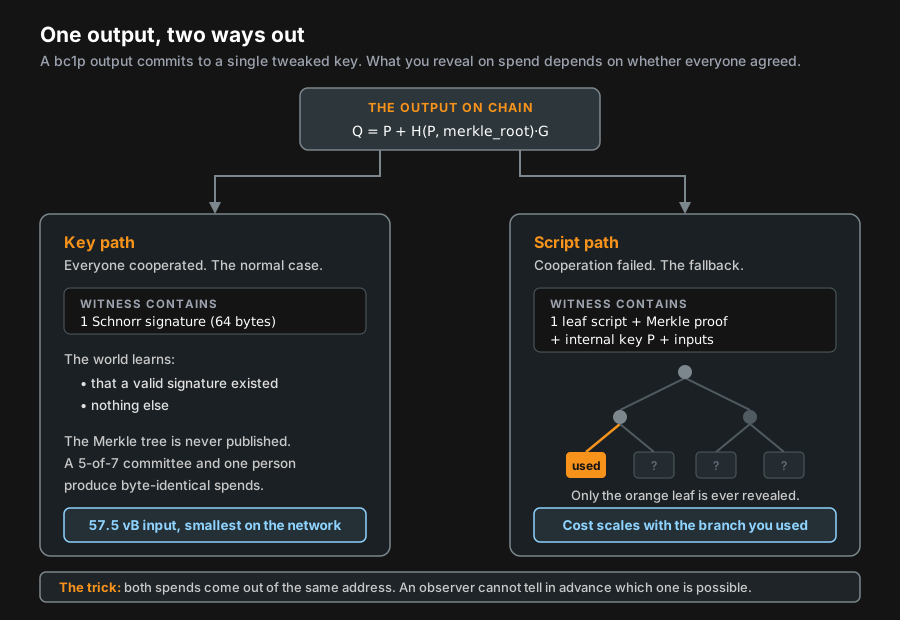
Taproot activated at block 709632 on 14 November 2021. It did three things: it replaced ECDSA with Schnorr signatures for the new output type, it let a single output carry a whole tree of alternative spending conditions, and it arranged matters so that when everyone cooperates, only one signature is ever published and nobody learns what the alternatives were.
That third item is the one worth understanding. Taproot's headline benefit is not speed and it is barely fees. It is that a 5-of-7 corporate treasury and one person moving pocket money can produce spends that are byte-for-byte indistinguishable.
What actually changed?
Three specifications, deployed together. BIP-340 defines Schnorr signatures for secp256k1. BIP-341 defines the Taproot output type and its spending rules. BIP-342, usually called tapscript, defines what scripting looks like inside the new type. All three read Status: Deployed in the BIPs repository, alongside the two supporting specs that gave Taproot its address format and its derivation path.
Schnorr signatures are 64 bytes, against the 71 or 72 a DER-encoded ECDSA signature usually needs. Seven bytes is not why anyone cared. They cared because Schnorr signatures are linear, so keys and signatures can be added together. Several parties can combine into one key that spends with one signature, and the chain sees a single-key spend because that is genuinely what it is.
The Merkle tree of scripts is the second half. Instead of publishing every possible spending condition, a Taproot output commits to the root of a tree of them. The maths is on the diagram above: the output key Q is an internal key P tweaked by a hash of P and the Merkle root. If everyone signs, that tweak is never mentioned again. If they cannot, exactly one leaf gets revealed with a proof that it belonged to the tree.
It is worth being concrete about why linearity matters, because "signature aggregation" gets said a lot and explained rarely. With ECDSA, a 2-of-3 arrangement had to publish two separate signatures and enough script to prove which two were required. The witness grew with the complexity of the policy, and the policy itself became public the moment you spent. With Schnorr, the three parties can produce one combined key in advance and one combined signature at spending time. The chain sees a single key and a single signature, because at the level the chain cares about that is precisely what it is.
| ECDSA | Schnorr (BIP-340) | |
|---|---|---|
| Signature size | 71 to 72 bytes, DER-encoded | 64 bytes, fixed |
| Can keys be combined? | No | Yes, they add |
| A 2-of-3 spend publishes | Two signatures plus the policy | One signature, policy hidden |
| Batch verification | No | Yes, faster for full nodes |
| Security proof | Relies on stronger assumptions | Cleaner, under standard assumptions |
The catch is that combining signatures safely is harder than adding numbers. Naive schemes leak private keys to a malicious co-signer, which is why the protocols that do this properly need several communication rounds and careful nonce handling. That work happens in wallet software rather than in consensus, which is part of why the benefit took years to reach ordinary users even though the capability activated in 2021.
Tapscript quietly removed two limits that had been there since the beginning. The 10,000-byte cap on script size no longer applies, and neither does the 201 non-push opcode limit. Both were dropped for defensible reasons that BIP-342 spells out. Both also turned out to matter for something nobody was discussing in 2019, which we cover in the piece on Ordinals.
| Spec | Title | BIP status | What it gave us |
|---|---|---|---|
| BIP-340 | Schnorr Signatures for secp256k1 | Deployed | 64-byte signatures, linear so keys and signatures can be aggregated |
| BIP-341 | Taproot: SegWit v1 spending rules | Deployed | The bc1p output type, key-path and script-path spending, the tweaked key |
| BIP-342 | Validation of Taproot Scripts | Deployed | Tapscript. Dropped the 10,000-byte script cap and the 201-opcode limit |
| BIP-350 | Bech32m for v1+ witness addresses | Deployed | The address encoding, with a fixed checksum constant |
| BIP-86 | Key derivation for single-key P2TR | Deployed | The m/86'/0'/0' derivation path wallets use for Taproot accounts |
How did it activate without a war?
Bitcoin's previous consensus change had been ugly enough that the mechanism was redesigned before anyone attempted another one. The result was nicknamed Speedy Trial, and its parameters are spelled out in BIP-341's deployment section.
Signalling opened at midnight on 24 April 2021 and would have timed out at midnight on 11 August 2021. Miners signalled on bit 2, and the threshold was lowered from the customary 95 percent to 1815 blocks out of 2016, which is 90 percent. Lock-in came in June, well inside the window.
Then nothing happened for five months, on purpose.
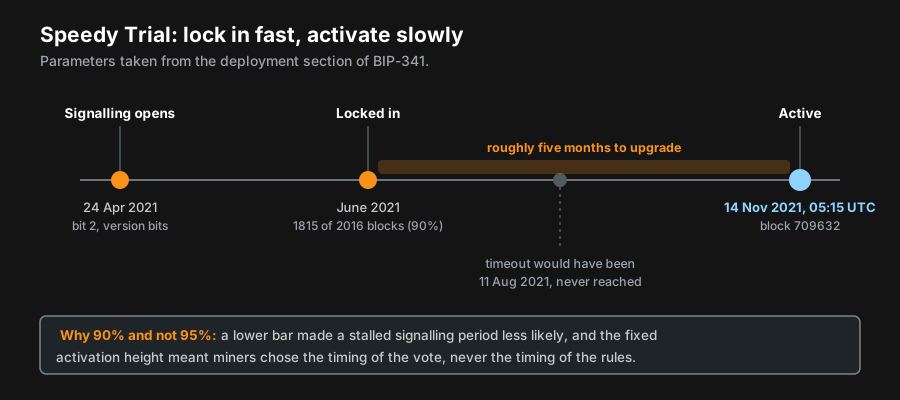
That separation is the part worth taking away. A fixed min_activation_height of 709632 meant the new rules could not come into force early even with unanimous mining support, so every node operator had months of notice. Block 709632 was mined at 05:15 UTC on 14 November 2021, and Bitcoin has not changed its consensus rules since.
Is anyone actually using it?
Here the honest answer diverges from the usual one, so we counted rather than quoted.
We tallied every transaction in three full blocks spread across nine days in July 2026, classifying every input by the type of output it spent and every output by the type it created. Not a sample of each block. All of it.
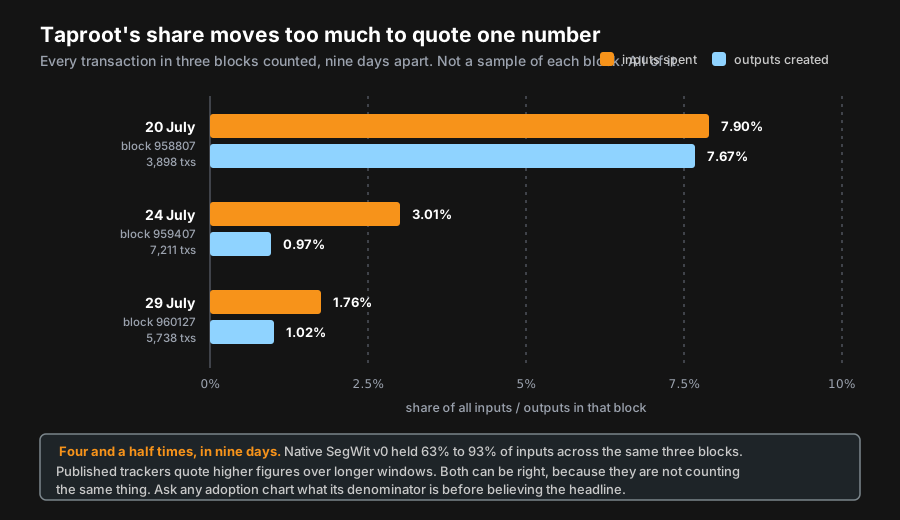
Two things stand out. The first is that Taproot's share of real spending is low: between 1.76 and 7.90 percent of inputs across those three blocks, while native SegWit version 0 held between 63 and 93 percent. Nearly five years after activation, most of Bitcoin still moves through bc1q.
The second is the volatility. A number that quadruples inside nine days is not measuring steady user adoption; it is measuring whatever burst of activity happened to fill those blocks. Published trackers report considerably higher Taproot figures over longer windows, and they are not necessarily wrong: they may be counting transactions rather than inputs, or weighting by volume, or averaging across months that include heavy inscription activity. Different denominators, different answers. That is the actual lesson, and it applies to every adoption chart you will ever be shown.
| Script type | Share of inputs | Share of outputs |
|---|---|---|
| P2WPKH native SegWit v0 | 73.32% | 46.77% |
| OP_RETURN data carrier | not spendable | 37.61% |
| P2WSH SegWit v0 script | 6.99% | 4.42% |
| P2TR Taproot | 4.41% | 2.82% |
| P2PKH legacy | 4.41% | 2.08% |
| P2SH | 3.77% | 1.92% |
| Other or unclassified | 7.10% | 4.39% |
Why so slow? Three reasons, and none of them is that Taproot is bad.
The first is that the fee saving for a plain payment is close to nothing, which we work through below. Nobody rewrites withdrawal infrastructure for a rounding error, and exchanges in particular have every incentive to leave working code alone.
The second is that the benefits land on the parties least likely to move quickly. Taproot pays off for multisig, for scripted conditions, for treasury arrangements. Those are exactly the setups where changing anything means a review, a new backup procedure, and a fresh set of recovery instructions for people who did not enjoy learning the last set.
The third is that address support has to be universal before it is useful. A receiving address is only worth switching to if everyone who might pay you can encode it. That was a real obstacle for years and it is mostly, though not entirely, behind us now.
The pattern is familiar. SegWit took years to pass half the network too, and it had a much stronger fee argument behind it. Bitcoin upgrades on the timescale of the slowest important participant, which is frustrating to watch and is arguably the system working correctly.
Did Taproot make transactions cheaper?
For inputs, clearly. A Taproot key-path input is 57.5 virtual bytes, against 68 for a native SegWit v0 input and 148 for legacy. Spending is where the discount lives.
For outputs, no. A Taproot output is 43 vbytes against 31 for P2WPKH, because it commits to a full 32-byte key rather than a 20-byte hash. On an ordinary two-input, two-output payment those two effects nearly cancel and then tip slightly the wrong way. We worked through the exact figures in the guide to address types, and the short version is that for a plain single-key payment the difference is worth a few dozen satoshis in the wrong direction.
| Type | Input vB | Output vB | 2-in 2-out total |
|---|---|---|---|
| Legacy P2PKH | 148 | 34 | 374 |
| Native SegWit P2WPKH | 68 | 31 | 208.5 |
| Taproot P2TR, key path | 57.5 | 43 | 211.5 |
So the fee case for an ordinary wallet is roughly a wash, and "roughly a wash" does not make exchanges rewrite withdrawal code. Where Taproot wins outright is narrower and more interesting:
- Multisig. A cooperative spend of an aggregated multisig costs the same 57.5 vbytes as any single-key spend, instead of the much heavier witness a P2WSH multisig input carries. If you run a multisig wallet, this is the upgrade.
- Input-heavy transactions. Consolidating many small outputs is all input cost, so the discount compounds and the larger output stops mattering.
- Complex conditions. Inheritance timelocks, escrow, spending policies with several fallbacks. Under the old rules every branch had to be published; under Taproot the unused ones stay private forever. That matters directly for inheritance planning, where the whole arrangement used to be visible the moment you spent.
| What you are doing | Worth switching? | Why |
|---|---|---|
| Multisig of any kind | Yes, clearly | Cooperative spend costs 57.5 vB and looks like a single-key payment |
| Sweeping many small inputs | Yes | The input discount compounds; the bigger output stops mattering |
| Timelocks, escrow, inheritance | Yes | Unused branches are never published, so the policy stays private |
| Ordinary single-key payment | Barely | Smaller input, larger output. On a 2-in 2-out spend they cancel out |
| Receiving from an old exchange | No | Some software still cannot encode bc1p. Use bc1q and move on |
| Anything, versus a legacy 1 address | Yes | 148 vB per input, forever. That is the gap that actually costs money |
What does it do for privacy?
More than the fee story suggests, and it is structural rather than optional.
Before Taproot, a script's complexity was written on the chain whenever you spent. A 2-of-3 looked like a 2-of-3. A timelock announced itself. Anyone watching could infer how you stored your coins and often why. With a key-path Taproot spend, all of that vanishes into one 64-byte signature that looks like every other one.
The catch is that this only holds when everyone cooperates. Fall back to the script path and you publish the branch you used, and a script-path spend on a chain where most Taproot spends are key-path is itself a signal. The privacy is real but it is contingent, and the contingency is that your arrangement works as intended.
| Signal | Key-path spend | Script-path spend |
|---|---|---|
| How many keys were required | Hidden | Revealed for the branch used |
| That a timelock or fallback exists | Hidden | Revealed if you used it |
| The branches you did not use | Hidden | Still hidden |
| The amounts | Visible | Visible |
| Which inputs paid which outputs | Visible | Visible |
| That inputs likely share an owner | Visible | Visible |
Worth being precise about what Taproot does not do: it does not hide amounts, it does not break the link between inputs and outputs, and it does nothing about the assumption that all inputs to a transaction share an owner. Those need different tools, which we cover in Bitcoin privacy and CoinJoin.
Should you be using bc1p?
If you run multisig, yes, and it is the single best argument for switching. If you hold a lot of small outputs you will eventually sweep, yes. If you want the privacy properties on a complex spending policy, yes.
If you are one person with one key making ordinary payments, it genuinely does not matter much, and anyone insisting otherwise is overselling a few dozen satoshis. Both bc1q and bc1p are modern, both are cheap, and the meaningful gap is between either of them and a legacy 1 address, not between the two of them.
There is also a category of thing Taproot was expected to enable that has not really arrived, and it is worth naming rather than glossing over. The tree of scripts makes elaborate spending policies cheap and private, which in 2021 people expected to produce a wave of consumer products: shared custody with graceful fallbacks, inheritance that quietly activates, escrow that costs nothing when everyone behaves. Five years on, those exist mostly as capable software for people who already understand the problem, not as products your relatives could use. The constraint turned out not to be the protocol.
Two practical notes. Restoring a Taproot wallet needs the BIP-86 derivation path, m/86'/0'/0', and a wallet that only scans BIP-84 will show you an empty balance while the coins sit safely on a branch it never looked at. And a few older exchanges still cannot send to bc1p. That is a limitation of their software rather than of the network, and in 2026 it says something about how much engineering attention the company gets.
The last observation is about Bitcoin rather than Taproot. The most recent change to Bitcoin's consensus rules is now approaching five years old. Proposals are plentiful, and BIP-119 remains Draft while BIP-347 reads Complete, which describes a finished document and not a deployment. Whether that stability reads as calcification or as the system working exactly as intended is the argument underneath most Bitcoin development disputes, and it is worth noticing that the same fact is the strongest evidence for both positions.
Related on BTCLinks
Sources
- BIP-341: Taproot, SegWit version 1 spending rules. Source of the output construction, the deployment parameters (start 24 April 2021, timeout 11 August 2021, threshold 1815 of 2016, min_activation_height 709632) and the line confirming the deployment did activate at that height. Verified 2026-07-29.
- BIP-340: Schnorr Signatures for secp256k1. Status read as Deployed from the specification header. Verified 2026-07-29.
- BIP-342: Validation of Taproot Scripts. Source of the resource-limit changes, quoted directly: the 10,000-byte maximum script size does not apply, the 201 non-push opcode limit does not apply, and the 520-byte stack element limit remains. Verified 2026-07-29.
- Block 709632 on Blockstream Esplora. Confirms the activation block timestamp of 14 November 2021, 05:15:27 UTC. Verified 2026-07-29.
- Blockstream Esplora API. Every transaction in blocks 958807, 959407 and 960127 was retrieved and classified by script type to produce the adoption chart. Counts: 3,898, 7,211 and 5,738 non-coinbase transactions respectively. Collected 2026-07-29.
- Bitcoin Optech: Preparing for Taproot. Source of the 57.5, 68 and 148 vbyte input figures and the 43 and 31 vbyte output figures. Verified 2026-07-29.
- BIP-119: CHECKTEMPLATEVERIFY. Status read as Draft. Verified 2026-07-29.
- BIP-347: OP_CAT in Tapscript. Status read as Complete, layer Consensus (soft fork), confirming the specification is finished rather than activated. Verified 2026-07-29.
Some links are affiliate links. As an Amazon Associate we earn from qualifying purchases. Not financial advice.