Bitcoin vs Gold as a Store of Value
Gold's above-ground stock was 219,891 tonnes at the end of 2025, worth about $28.4 trillion at the LBMA afternoon price on 28 July 2026. Bitcoin's market capitalisation the next day was about $1.28 trillion. Gold is roughly 22 times larger. It is also older, calmer, and physically inconvenient in ways Bitcoin is not, while Bitcoin is capped, divisible and cheap to verify in ways gold is not. Those are the real differences, and most of them can be measured.
This is a comparison of properties, not investment advice. There is no recommendation here, no allocation, and no price forecast in either direction. Every figure is dated because every figure moves. What either asset does next is not something this page claims to know.
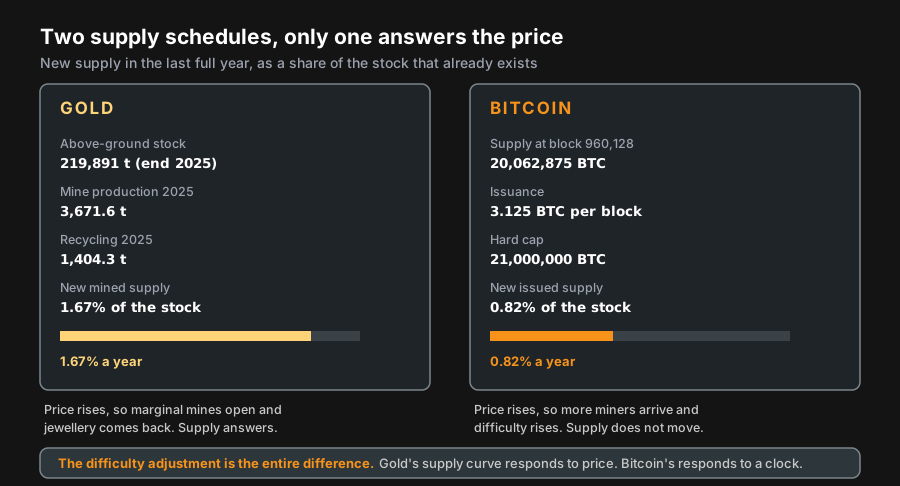
How big is each one, really?
Size is the first thing to settle, because it silently drives every other comparison. A 22 to 1 gap is not a detail. It explains most of the volatility difference on its own, and it means the two assets are at completely different points in their lives.
| Gold | Bitcoin | |
|---|---|---|
| Total stock | 219,891 tonnes (end 2025) | 20,062,875 BTC (block 960,128) |
| Price used | $4,022.20 per troy ounce | $63,932 |
| Value of the stock | about $28.4 trillion | about $1.28 trillion |
| New supply last full year | 3,671.6 t mined, 1,404.3 t recycled | about 164,250 BTC issued |
| New supply as a share of stock | 1.67% mined | 0.82% issued |
| Can new supply respond to price? | Yes, through mines and recycling | No, difficulty absorbs it |
| Terminal supply | Unknown, still being mined | 21,000,000, enforced by every node |
| Smallest practical unit | A 1 g bar, about $129 | One satoshi, a hundred millionth of a coin |
| Wholesale unit | A 400 oz Good Delivery bar, about $1.6m | Any amount, no minimum |
One consequence of the size gap deserves stating plainly, because it cuts against Bitcoin. A $1.28 trillion asset can be moved by flows that a $28.4 trillion asset would absorb without noticing. When people describe Bitcoin as volatile, a large part of what they are describing is simply an asset that has not yet grown into the depth that dampens gold.
The two supply schedules are not the same kind of thing
Gold and Bitcoin are both described as scarce, and the word hides the interesting part. Gold's scarcity is an economic fact: it is expensive to find and expensive to dig, so not much of it appears each year. Bitcoin's scarcity is a rule: the software will not create more than 21 million, and every node checks that on every block.
The practical difference shows up when the price rises. A higher gold price makes marginal deposits economic, funds exploration, and pulls jewellery back into refineries. In 2025 recycling reached 1,404.3 tonnes, the highest since 2012, which the World Gold Council itself called a muted response to a 67 percent rise in the dollar price. Muted or not, it responded. Supply went up because the price went up.
Bitcoin cannot do that. A higher price attracts more mining, more hardware and more electricity, and the difficulty adjustment raises the target every 2,016 blocks so that blocks keep arriving about every ten minutes. The extra effort buys more security, not more coins. Issuance stays at 3.125 BTC per block until block 1,050,000, when it halves again to 1.5625. Our guide to the halving schedule works through how that plays out to the last satoshi.
This is the one property where Bitcoin is genuinely, structurally different from every commodity, gold included. It is worth being precise about it rather than reaching for slogans, because the mechanism is more convincing than the slogan.
Which one can you actually check?
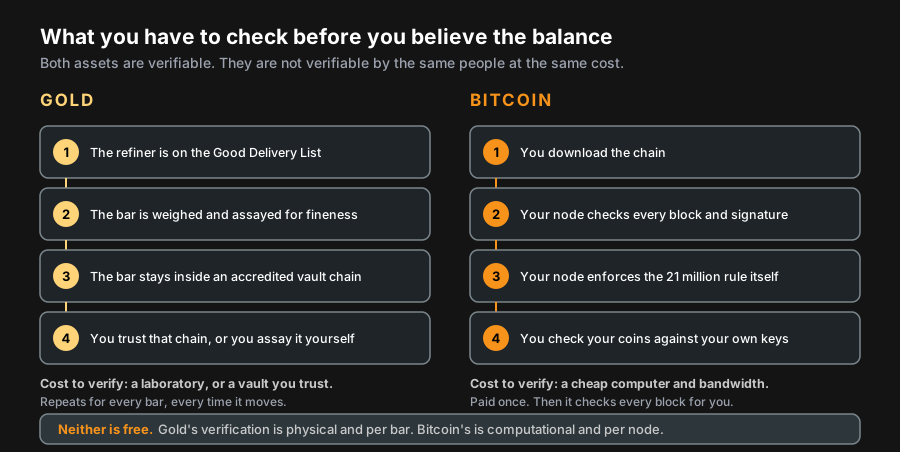
Gold solves the verification problem with institutions. The LBMA maintains a Good Delivery List of accredited refiners, and only bars from those refiners settle a Loco London contract. Accreditation is not casual: a refiner needs a minimum tangible net worth of £15 million and must refine at least 10 tonnes of gold a year, among other requirements. Once a bar is inside the accredited vault chain, institutions trade it without re-assaying, which is efficient precisely because the chain is trusted.
That system works well and has one honest weakness. If a bar leaves the chain, its provenance leaves with it, and a bar bought outside that chain has to be trusted or tested. Drilling and assaying a bar costs money and damages it. Non-destructive testing exists and is imperfect. Nothing about this makes gold a bad asset, but it does mean the ordinary holder of a coin or a small bar is trusting a dealer rather than checking anything.
Bitcoin moves that cost into software. A full node downloads the chain and validates every block, every signature and the issuance schedule itself, then tells you whether the coins you think you have exist and are yours. It runs on cheap hardware. It does not care who sold you the coins. We cover the practical side in our guide to running a full node, and the honest caveat is that hardly anybody does it, which weakens the property considerably in practice even though it remains available.
What does it cost to hold?
Here the two assets fail in opposite directions, and the failure modes are worth putting side by side rather than arguing about which is worse.
| Holding $1 million | Gold | Bitcoin |
|---|---|---|
| What you physically store | About 7.7 kg of metal | A key, of no weight at all |
| Home storage | Possible, heavy, and visible | Possible, invisible, and easy to lose |
| Moving it across a border | Freight, insurance, declaration | A memorised phrase, or a signature |
| Sending it to someone | Days, a courier, and paperwork | Minutes, and a network fee |
| Divisible for a payment | Not without a refiner | To eight decimal places |
| Loss by user error | Rare, the metal survives fire | Common, and permanent |
| Loss by remote attack | Not possible | The main way people lose it |
| Confiscation resistance | Poor once located, it cannot be memorised | Strong if self-custodied, nil in an ETF |
| Needs electricity to use | No | Yes, and a network |
Gold's custody model is old, boring and hard to attack remotely. Nobody has ever lost a vault of bullion to a phishing email. The cost is physical: storage, insurance, freight and the fact that you cannot send it to another continent this afternoon.
Bitcoin inverts all of it. Storage is free and weightless, transfer is minutes, and the whole balance can sit behind twelve words. The same properties are why self-custody goes wrong so often, which is the subject of our cold storage guide and, if you would rather hold exposure through a fund and accept a custodian, our guide to spot Bitcoin ETFs. A share in a fund is not a bitcoin you can move, and the same caveat applies to a gold ETF.
How much does the price actually move?
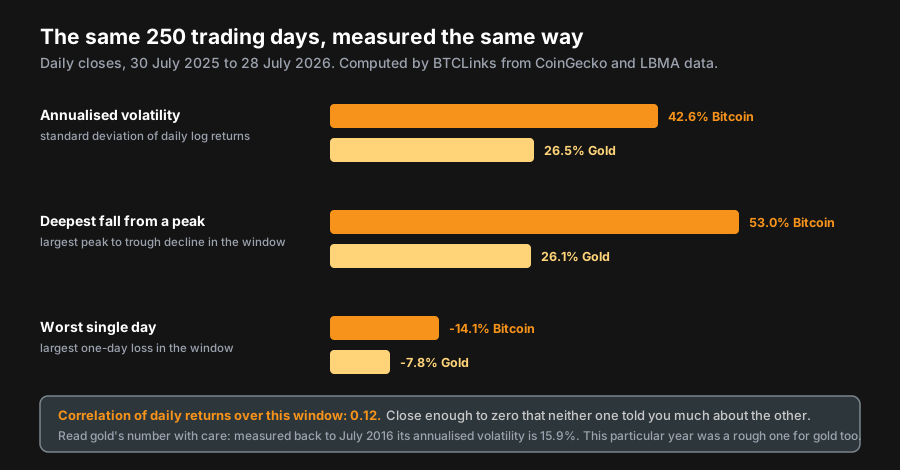
We computed these rather than quoting them, because volatility figures circulate with no window attached and are usually chosen to make a point. The method: daily closes for both assets over the same 250 trading days, log returns, standard deviation, annualised on the same base. Bitcoin came out at 42.6 percent against gold's 26.5 percent.
Two things about that pair are more interesting than the headline. The first is that 1.6 to 1 is a much smaller gap than the usual framing implies, and anyone expecting five or ten to one should look at the arithmetic. The second is that gold's 26.5 percent is unusual for gold. Measured from July 2016 across more than 2,500 trading days, gold's annualised volatility is 15.9 percent. The year to July 2026 was a violent one for the metal too, with an LBMA price that ran to $5,405 and came back to $4,022.
The drawdown row is the one to take seriously if you are trying to understand what holding either asset feels like. Bitcoin fell 53.0 percent from its peak inside those twelve months. That is not an anomaly in Bitcoin's record, it is close to routine, and no amount of supply-schedule elegance changes what a halving of your position does to your judgment.
Do they move together?
Barely. The correlation of daily log returns over the same window was 0.12. Close enough to zero that on any given day one told you almost nothing about the other.
Resist building anything on that number. Correlation over short windows is unstable, it has been higher and it has been negative in other periods, and it tends to rise toward one in exactly the moments when people were counting on it not to. The honest reading is narrow: over this particular year, these two did not move as a pair.
In the US, the tax treatment genuinely differs
This one surprises people, and it is a real difference rather than a technicality. IRS Topic 409 states that net capital gains from selling collectibles are taxed at a maximum 28 percent rate, and the statutory definition of a collectible at 26 U.S.C. section 408(m)(2) includes "any metal or gem" alongside art, rugs and coins. Long-term gains on Bitcoin fall in the ordinary 0, 15 and 20 percent brackets.
| Held more than one year | Bitcoin | Physical gold |
|---|---|---|
| Federal classification | Property, ordinary capital asset | Collectible under section 408(m)(2) |
| Long-term rate brackets | 0%, 15%, 20% | Up to a 28% maximum |
| Federal ceiling | 20% | 28% |
| Held one year or less | Ordinary income rates | Ordinary income rates |
So on the same gain, held for the same length of time, the federal ceiling is eight percentage points apart. Which vehicle you hold matters too, and the treatment of specific gold funds and of metals held inside retirement accounts has its own rules, including a carve-out at section 408(m)(3) for certain bullion held by an approved trustee. Take your actual position to a professional rather than working from a table. Our Bitcoin tax guide covers the digital asset side, including the wallet-by-wallet basis rule that came in for 2025.
Where each one is weak
Every comparison of these two gets written by someone with a position. Here is the version that gives each side its best shot at the other, before we take each in turn.
| The charge | Against Bitcoin | Against gold |
|---|---|---|
| Track record | Since 2009, two cycles | Thousands of years |
| Non-monetary demand | None at all | Jewellery 44%, industrial and other 15% |
| Supply guarantee | A rule, enforced by every node | An estimate, and it grows with price |
| Worst 12-month fall observed here | 53.0% | 26.1% |
| Verification by an ordinary holder | Available, and rarely done | Not practical without a lab |
| Cost of moving it | A network fee | Freight, insurance, customs |
| US federal ceiling on long-term gains | 20% | 28% as a collectible |
| Long-run open question | Whether fees replace the halving subsidy | Whether cheaper extraction lifts supply |
The strongest argument against Bitcoin
Bitcoin has been around since 2009. Gold has been a monetary metal for thousands of years, and roughly two-thirds of all the gold ever mined came out of the ground since 1950, which tells you the stock has survived every monetary system of the modern era. Seventeen years is not a track record. It is a promising start with two market cycles in it.
Worse for the argument, Bitcoin's demand is reflexive in a way gold's is not. About 44 percent of the above-ground gold stock is jewellery and another 15 percent sits in industrial and other uses, so a meaningful part of gold demand exists for reasons that have nothing to do with anyone's monetary opinion. Bitcoin has no such floor. Its value rests entirely on the expectation that other people will keep valuing it, which is a real expectation with real momentum, and also one that can change faster than a metal's five thousand years of habit.
Then there is the 53 percent drawdown above, and a design question that matters more than either. Bitcoin's security is paid for out of the block subsidy plus transaction fees, and the subsidy is on a schedule that only goes one way.
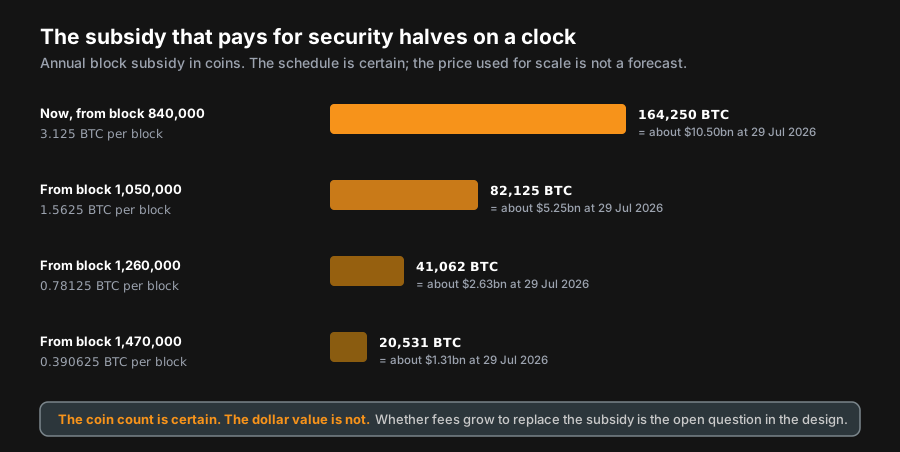
Whether transaction fees grow enough to replace that subsidy is genuinely unsettled, and it is the most substantive long-horizon criticism of the design. Gold has no equivalent problem, because a bar in a vault costs nothing to keep secure beyond the vault. Our piece on fees and the mempool covers where the fee side stands now.
The strongest argument against gold
Gold's supply cannot be pinned down. Nobody knows the terminal figure, the annual addition is 1.67 percent and rising with price, and there is no mechanism that would stop a very large discovery or a cheaper extraction method from adding more. Compared with a cap that every node enforces on every block, "we probably will not find much more" is a weaker guarantee than it sounds.
Its second problem is that ordinary people cannot really hold the good version of it. The wholesale market runs on 400 ounce bars worth about $1.6 million, and everything below that carries dealer premiums, spreads and assay questions. Verification is the part that has been engineered out for institutions and never engineered for anyone else.
Third, settlement is slow and physical. Gold that has to be shipped, insured and cleared is not an asset you can move at short notice, and a holding that must stay in one jurisdiction is a holding exposed to that jurisdiction. Fourth, in the US the collectibles rate above is a genuine drag on after-tax returns. And fifth, gold pays nothing while it sits, which it has in common with Bitcoin and which both camps tend to mention only about the other one.
So which is the better store of value?
We are not going to answer that, and any page that does should be read carefully to see what it is selling.
What we will do is name the questions that actually decide it for a given holder. Each one is really a question about a property, and each property sits with one asset or the other.
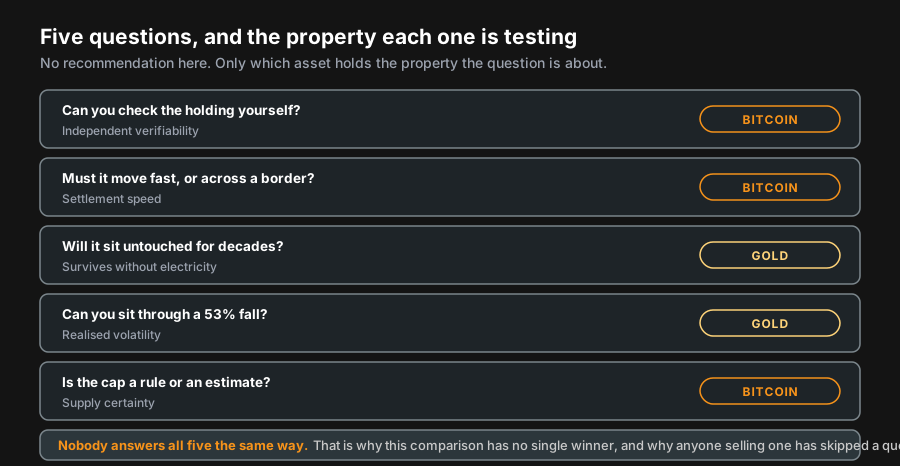
There is a sixth question that no diagram handles, and it is the one worth sitting with: which failure would hurt more, a seed phrase you lost, or a vault you cannot reach?
Different answers point different ways, which is why the sensible version of this argument usually ends with people holding some of both and not treating either as a religion. The comparison that is worth having is a comparison of properties. Those are above, they are dated, and most of them you can check yourself. If you are working out how to hold either one properly, our guides to custodial and non-custodial wallets and to business custody pick up where this one stops.
Related on BTCLinks
Sources
- World Gold Council: How much gold has been mined?. Source of the 219,891 tonne above-ground stock at end 2025 and the split into jewellery 44%, bars and coins 23%, central banks 18% and other uses 15%, plus the statement that around two-thirds has been mined since 1950. Verified 2026-07-29.
- World Gold Council, Gold Demand Trends full year 2025: Supply. Source of 2025 mine production of 3,671.6 tonnes, recycling of 1,404.3 tonnes, total supply of 5,002.3 tonnes, and the description of recycling as a muted response to a 67% price rise. Verified 2026-07-29.
- LBMA precious metal prices. Source of the gold afternoon price of $4,022.20 per troy ounce on 28 July 2026 and the full daily price series used for the volatility, drawdown and correlation figures. Read from the LBMA gold PM data feed and verified 2026-07-29.
- CoinGecko: Bitcoin. Source of the $63,932 price and the roughly $1.28 trillion market capitalisation on 29 July 2026, and of the daily close series used in the volatility computation. Verified 2026-07-29.
- Blockchain.com explorer data. Source of the circulating supply of 20,062,875 BTC at block height 960,128 on 29 July 2026, from which the 0.82% annual issuance rate is computed. Verified 2026-07-29.
- LBMA Good Delivery. Source of the accreditation requirements for refiners, including the minimum tangible net worth of £15 million and minimum annual refined output of 10 tonnes of gold, and of the approximately 400 troy ounce Good Delivery gold bar used for Loco London settlement. Verified 2026-07-29.
- IRS Topic no. 409, Capital gains and losses. Source of the statement that net capital gains from selling collectibles are taxed at a maximum 28% rate, and of the ordinary 0, 15 and 20 percent long-term brackets. Verified 2026-07-29.
- 26 U.S.C. section 408(m). The statutory definition of a collectible, which includes "any metal or gem," and the section 408(m)(3) carve-out for certain bullion held by an approved trustee. Verified 2026-07-29.
General information only. Not investment, tax or financial advice, and no forecast of any price is offered or implied. Figures are dated and will move. Some links on this site are affiliate links.